Introduction: The Stark Counterpoint to Joy
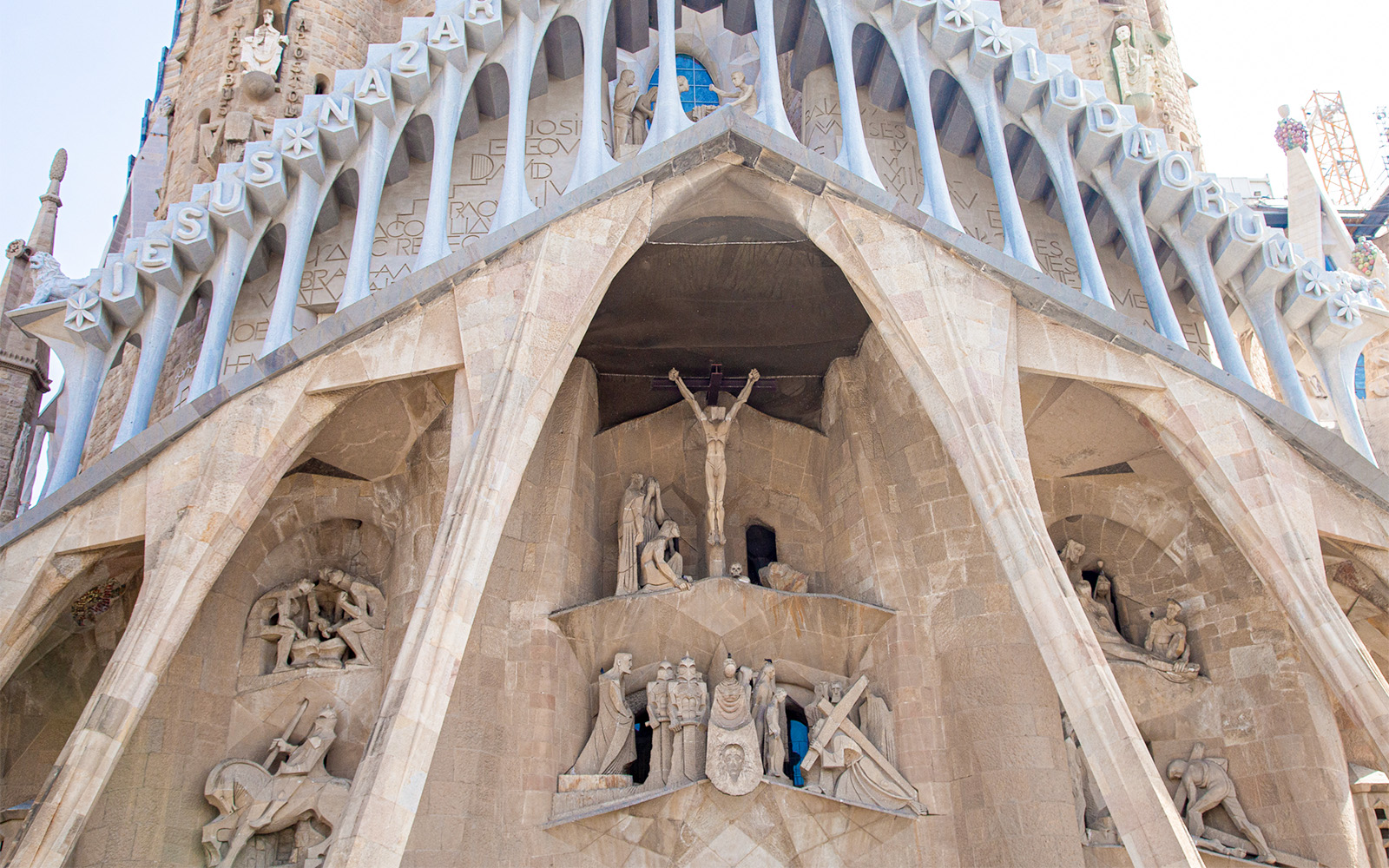
If the Nativity Façade is a celebration of birth, life, and abundance, the Passion Façade is its profound opposite: a meditation on suffering, sacrifice, and the cost of redemption.
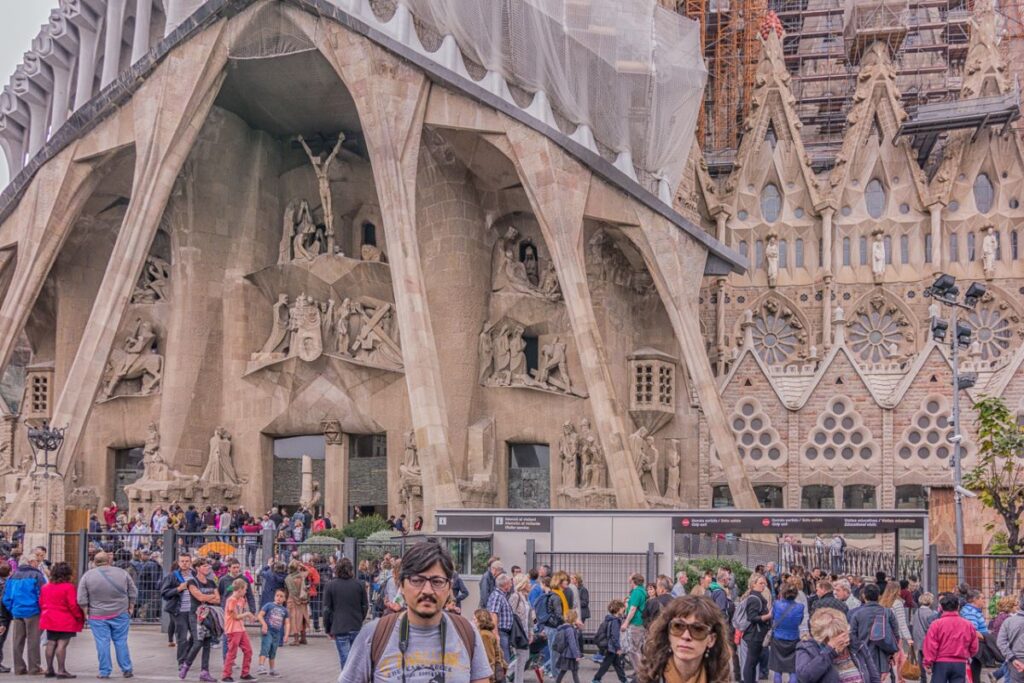
Facing west toward the setting sun, this façade strips away ornament to reveal raw, angular forms that seem carved from bone rather than stone. Where the Nativity Façade overflows with flora, fauna, and joyful detail, the Passion Façade stands bare, austere, and confrontational. It doesn’t invite you to admire—it demands that you feel.
Antoni Gaudí designed this façade to depict the Passion and death of Jesus Christ, but he knew he would not live to see it built. He left sketches, notes, and a clear vision: the architecture itself should express suffering through its very form. The task of realizing this vision fell to sculptor Josep Maria Subirachs, whose stark, expressionist style brought Gaudí’s concept to life in a way that sparked both admiration and controversy.
For tourists visiting the Sagrada Família, understanding the Passion Façade is essential to grasping the basilica’s complete theological narrative. When you know what to look for—the Magic Square adding to 33, the stark figures of the Last Supper, the skeletal columns representing death—you don’t just see stone. You witness a visual sermon on sacrifice, love, and hope born from suffering.
This comprehensive guide reveals:
- 📜 The history: From Gaudí’s sketches to Subirachs’ sculptures
- 🎨 The symbolism: Every angular form and biblical scene decoded
- 🔍 Hidden details: The Magic Square, secret inscriptions, and overlooked elements
- 📸 Best photography spots: Light, angles, and timing for dramatic shots
- 🗺️ Where to stand: Optimal viewing locations and perspectives
- ⏰ When to visit: Perfect light conditions for the west-facing façade
- 🎯 Must-see elements: Your checklist for the complete experience
Whether you’re drawn to religious art, architectural innovation, powerful sculpture, or simply the story behind one of the world’s most extraordinary buildings—this guide unlocks the Passion Façade’s profound message so you can experience it with the depth it deserves.
Chapter 1: Historical Context – From Gaudí’s Vision to Subirachs’ Sculpture
📅 Gaudí’s Original Concept (1917-1926)
While the Nativity Façade was substantially complete during Gaudí’s lifetime, the Passion Façade existed primarily in his imagination, sketches, and a few plaster models.
Gaudí’s Design Philosophy for the Passion Façade:
Unlike the ornate, nature-filled Nativity Façade, Gaudí envisioned the Passion Façade as:
- Stark and angular: Forms should feel stripped bare, like bones
- Minimal ornamentation: No floral details; pure structural expression
- Dramatic shadows: Deep recesses to emphasize suffering
- Narrative clarity: Biblical scenes should be immediately legible
- Emotional impact: The architecture itself should evoke the weight of Christ’s sacrifice
Why This Contrast? Gaudí explained his reasoning clearly:
“The Nativity Façade is life, joy, abundance. The Passion Façade must be death, sacrifice, austerity. One without the other is incomplete. Faith embraces both.”
This theological duality—birth and death, joy and suffering—is central to Christian understanding, and Gaudí made it architectural.
🏗️ Construction Timeline: 1954-2009
1954: Construction Begins After decades of delay due to the Spanish Civil War (which destroyed many of Gaudí’s models and plans), work finally began on the Passion Façade structure under architect Francesc Quintana, who had worked with Gaudí.
Key Decisions:
- Follow Gaudí’s structural concepts but adapt decorative elements
- Use reinforced concrete for efficiency, then clad in stone
- Prioritize the narrative sequence of Christ’s Passion
1976: Structural Completion The basic framework of the Passion Façade—its columns, arches, and overall form—was completed. The stark, skeletal structure was now visible, but the façade lacked its sculptural soul.
1986: Subirachs Enters the Project Catalan sculptor Josep Maria Subirachs i Sitjar was commissioned to create the sculptural program. This decision would prove both brilliant and controversial.
Who Was Josep Maria Subirachs?
- Born 1927 in Barcelona; died 2014
- Trained in classical sculpture but developed a modernist, expressionist style
- Known for angular, abstracted human forms
- Deeply familiar with Catalan culture and Catholic symbolism
- Shared Gaudí’s commitment to artistic integrity over commercial appeal
Subirachs’ Approach: Rather than imitate Gaudí’s organic naturalism, Subirachs chose a style that complemented the façade’s architectural intent:
- Angular, geometric forms: Echoing the façade’s skeletal structure
- Expressionist abstraction: Figures that convey emotion through form rather than realism
- Minimal detail: Letting negative space and shadow do the work
- Modern materials: Combining traditional stone with bronze and other media
1987-2009: Sculptural Installation Over 22 years, Subirachs and his team created and installed the façade’s sculptural program:
| Year | Major Installation |
|---|---|
| 1987 | Portal sculptures begin |
| 1990 | Last Supper frieze |
| 1995 | Kiss of Judas and Arrest of Jesus |
| 2000 | Crucifixion group |
| 2005 | Resurrection and Ascension elements |
| 2009 | Final details and inscriptions completed |
Controversy and Reception: Subirachs’ style divided opinion:
- Supporters praised the powerful emotional impact and faithful interpretation of Gaudí’s vision of austerity
- Critics argued the modernist style clashed with Gaudí’s organic aesthetic and lacked the warmth of the Nativity Façade
Gaudí’s assistants, who had worked with the master, largely endorsed Subirachs’ approach, recognizing that imitation would have betrayed Gaudí’s intent for contrast.
2009: Completion With the installation of the final sculptural elements, the Passion Façade was declared complete—83 years after Gaudí’s death, but faithful to his vision of stark, suffering beauty.
🎯 Why the Passion Façade Second?
Gaudí’s sequencing of the façades was deeply intentional:
- Nativity first: Begin with hope, life, and joy to inspire continued work
- Passion second: Confront the reality of suffering and sacrifice
- Glory last: Culminate in resurrection and eternal life
This order mirrors the Christian narrative and the spiritual journey: we begin with the wonder of incarnation, confront the cost of redemption, and arrive at the promise of glory.
Chapter 2: Architectural Design – Skeletons of Stone
💀 Gaudí’s Structural Vision
The Passion Façade’s architecture is as much a part of its message as its sculptures. Gaudí designed it to feel stripped bare, like a body after death.
Key Design Principles:
1. Angular Geometry Over Organic Curves
Where the Nativity Façade celebrates curves, the Passion Façade embraces angles:
- Columns that taper sharply like bones
- Arches that feel fractured rather than flowing
- Surfaces that seem carved by force rather than grown by nature
Symbolic Meaning: Angles evoke pain, tension, and the harsh reality of suffering.
2. Hyperboloid Structures with a Darker Tone
Gaudí still employed his signature hyperboloid and paraboloid forms, but with a different emotional effect:
- Hyperboloid windows: Create dramatic light/shadow contrasts
- Parabolic arches: Feel like ribs of a skeleton
- Helicoid elements: Suggest spiraling descent rather than upward growth
3. Minimal Ornament, Maximum Impact
Unlike the Nativity Façade’s abundant decoration, the Passion Façade is deliberately sparse:
- Bare stone surfaces
- Deep recesses that create dramatic shadows
- Sculptural elements that stand isolated, emphasizing their emotional weight
Effect: The emptiness itself becomes expressive—like silence in music, or negative space in art.
🏛️ Structural Innovation with Emotional Purpose
The Inclined, Skeletal Columns The Passion Façade’s columns lean at sharp angles, but unlike the Nativity Façade’s tree-like supports, these feel precarious:
- They suggest burden and strain
- Their sharp angles create visual tension
- They appear to bear weight painfully, not gracefully
Symbolic Meaning: Christ bearing the cross; humanity bearing the weight of sin.
The Portal Structure The three portals of the Passion Façade are simpler than those of the Nativity:
- Central Portal: The largest, depicting the Crucifixion
- Left Portal: Scenes of the Last Supper and Betrayal
- Right Portal: Resurrection and Ascension themes
Each portal is framed by stark, angular arches that feel like gates of judgment rather than welcoming entrances.
Light as a Theological Tool Gaudí understood that the west-facing orientation would affect the façade’s appearance:
- Afternoon light rakes across the angular surfaces, emphasizing every plane and shadow
- Sunset casts long, dramatic shadows that enhance the sense of suffering
- Evening illumination (artificial lighting) creates a stark, almost ghostly effect
Material Choices
- Stone: Same Montjuïc sandstone as the Nativity Façade, but left more raw and unpolished
- Bronze: Used for select sculptural elements (e.g., the Kiss of Judas) for contrast
- Concrete: Structural core, then clad in stone—efficient but hidden
Color Palette The stone’s natural beige-gold is the same as the Nativity Façade, but the lack of ornament and the play of shadow make it feel colder, more austere.
Chapter 3: Symbolism Decoded – Reading the Narrative of Suffering
The Passion Façade tells the story of Christ’s final days—from the Last Supper to the Crucifixion to the Resurrection. Every sculptural group, every inscription, every angular form contributes to this narrative.
🚪 The Three Portals: Betrayal, Sacrifice, and Hope
Central Portal: The Crucifixion
The Dominant Scene
Positioned at the center as the theological heart of the façade, this portal depicts the Crucifixion of Jesus—the moment of ultimate sacrifice.
Key Elements:
The Crucified Christ:
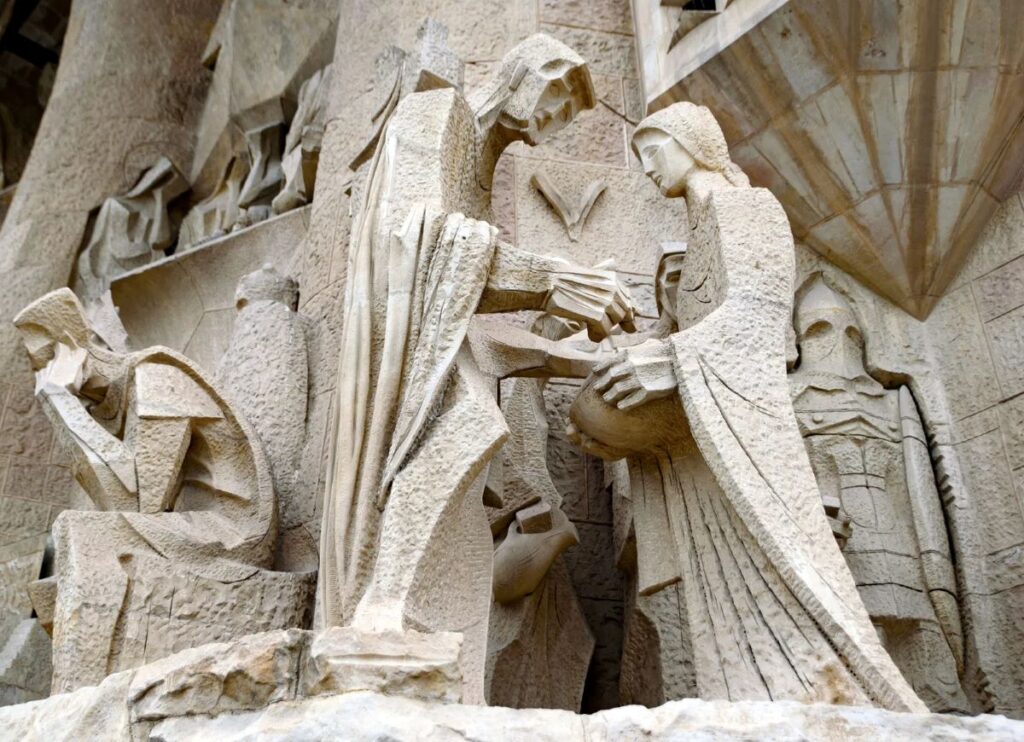
- Subirachs’ Christ is emaciated, angular, almost abstract
- Not a realistic depiction but an expression of suffering
- Arms outstretched in the traditional cruciform pose
- Face turned upward in surrender, not agony
Symbolic Meaning:
- Christ’s humanity and divinity united in sacrifice
- The weight of sin borne by one
- Love expressed through self-giving
The Three Marys:
- Mary (mother of Jesus), Mary Magdalene, and Mary of Clopas
- Positioned at the foot of the cross
- Subirachs renders them as angular, grief-stricken figures
- Their postures express sorrow without melodrama
The Centurion:
- Roman soldier who declared, “Truly this was the Son of God” (Matthew 27:54)
- Represents the moment of recognition and faith
- Subirachs depicts him in profile, looking upward
**The Skull and Bones **(Golgotha)
- At the base of the cross
- Traditional symbol of Calvary (“place of the skull”)
- Reminder of mortality and the cost of redemption
Inscriptions:
- “INRI” (Iesus Nazarenus, Rex Iudaeorum – Jesus of Nazareth, King of the Jews)
- Latin phrases from the Passion narratives
- Catalan text emphasizing local connection
Left Portal: The Last Supper and Betrayal
Scenes of Human Frailty
This portal depicts the events leading to Christ’s arrest: the Last Supper, the Agony in the Garden, and the Kiss of Judas.
Key Elements:
The Last Supper Frieze:
- Long horizontal sculpture above the portal
- Jesus and the twelve apostles at table
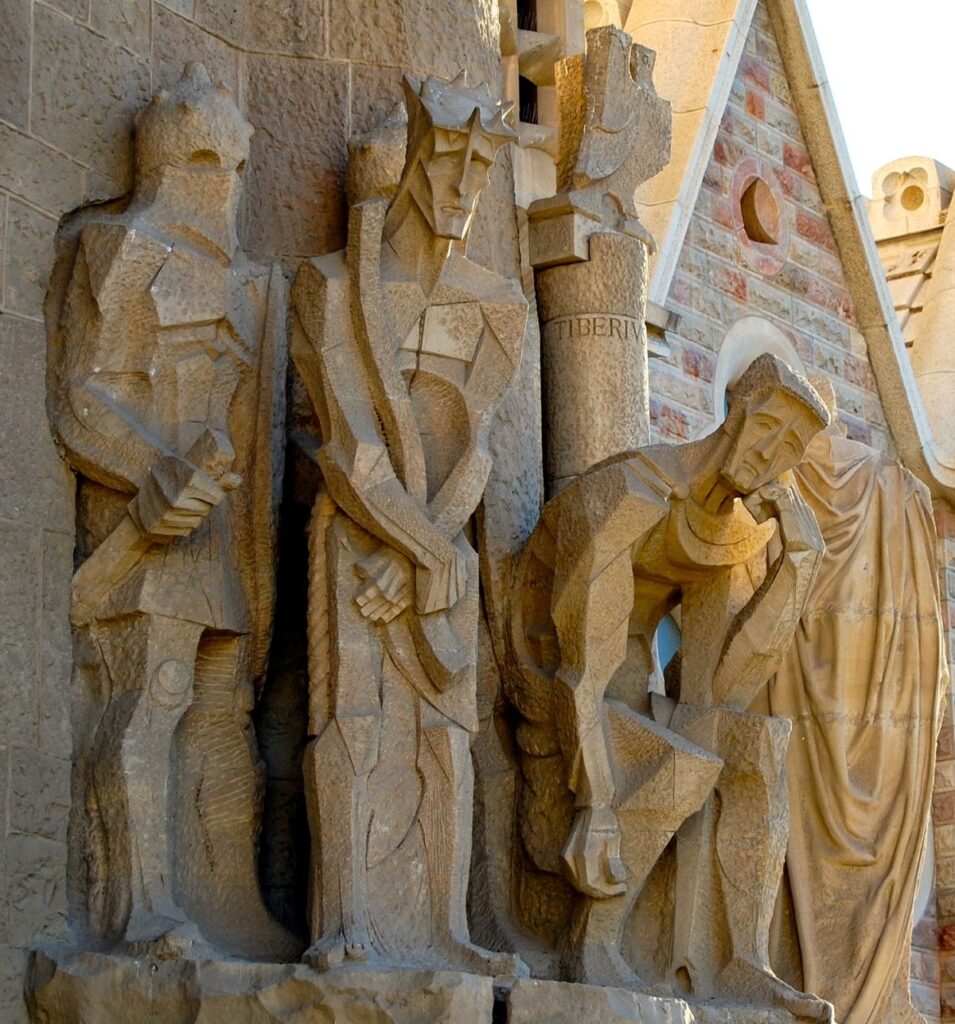
- Subirachs’ figures are angular, almost geometric
- Judas is subtly distinguished (turned away, holding a bag of silver)
Symbolic Details:
- Bread and wine simplified to essential forms (Eucharist)
- Apostles’ postures suggest confusion, denial, fear
- Jesus remains calm, centered—foreshadowing his acceptance
The Agony in the Garden:
- Jesus praying while disciples sleep
- Angel offering the cup of suffering
- Olive trees rendered as stark, twisted forms
The Kiss of Judas:
- One of Subirachs’ most powerful sculptures
- Judas embracing Jesus; the kiss that betrays
- Bronze material contrasts with stone, emphasizing the moment
- Jesus’ face is serene; Judas’ is shadowed, ambiguous
Symbolic Meaning:
- Betrayal by a friend
- The complexity of human choice
- Love that accepts even betrayal
The Arrest of Jesus:
- Soldiers with lanterns and weapons
- Peter cutting off the ear of the high priest’s servant
- Chaos rendered in angular, dynamic forms
Right Portal: Resurrection and Ascension
Hope Beyond Suffering
While the Passion Façade focuses on suffering, it does not end in despair. This portal points toward resurrection and hope.
Key Elements:
The Empty Tomb:
- Stone rolled away
- Angels announcing, “He is not here; he has risen”
- Light breaking through darkness
The Resurrection Appearance:
- Jesus appearing to Mary Magdalene (“Noli me tangere” – Do not hold on to me)
- Subirachs renders the moment with restraint and dignity
- Mary’s gesture of recognition and awe
The Ascension:
- Jesus ascending to heaven
- Disciples looking upward
- Clouds and light suggesting divine glory
Symbolic Meaning:
- Suffering is not the end
- Death is overcome by life
- Hope is born from sacrifice
🔢 The Magic Square: A Hidden Numerological Puzzle
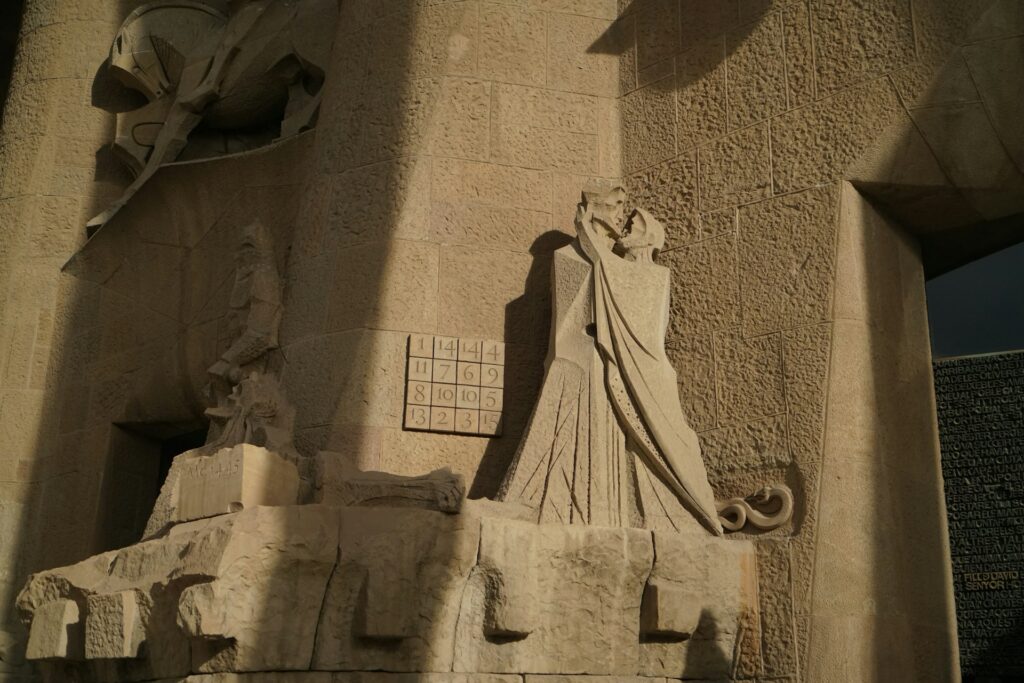
Location: On the Glory Portal (part of the Passion Façade complex), near the Kiss of Judas sculpture
What It Is: A 4×4 grid of numbers carved in stone:
1  14  14  4
11  7   6   9
8  10  10  5
13  2   3  15
The Puzzle: Add the numbers in any row, column, diagonal, or even certain groupings—and they always equal 33.
Why 33?
- The traditional age of Christ at his crucifixion
- A number of spiritual significance in Christian mysticism
- Also the number of degrees in Freemasonry (a subtle nod to Gaudí’s possible connections)
Additional Patterns:
- The two central numbers (10 and 10) add to 20; the two middle numbers of the middle row (7 and 6) add to 13; 20 + 13 = 33
- The four corner numbers (1, 4, 13, 15) add to 33
- Even the numbers in the four quadrants add to 33
Symbolic Meaning:
- Divine order underlying apparent chaos
- The perfection of Christ’s sacrifice
- A hidden message for those who look closely
Tourist Tip: Many visitors miss the Magic Square because it’s small and positioned high on the portal. Bring binoculars or zoom in with your camera.
✝️ Additional Symbolic Elements
**The Pelican **(Revisited) While the pelican appears prominently on the Nativity Façade as a symbol of charity, it also appears subtly on the Passion Façade—now emphasizing sacrifice rather than nurturing.
The Crown of Thorns:
- Depicted in sculptural details
- Symbol of Christ’s suffering and mockery
- Thorns rendered as sharp, angular forms
The Nails and Spear:
- Instruments of the Passion
- Rendered with stark simplicity
- Reminders of the physical reality of crucifixion
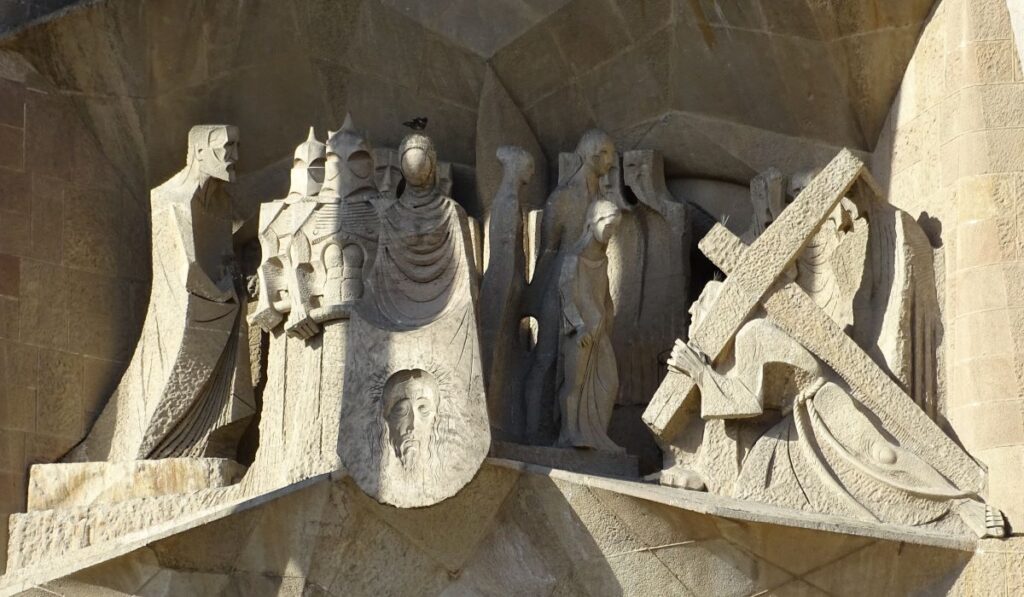
The Veil of Veronica:
- The cloth said to bear Christ’s face
- Symbol of compassion and witness
- Subirachs depicts it as a simple, powerful image
The Rooster:
- Symbol of Peter’s denial (“Before the rooster crows…”)
- Reminder of human weakness and forgiveness
- Positioned subtly near the Last Supper scenes
Olive Trees:
- Gethsemane, where Jesus prayed
- Symbol of peace, but also of suffering (olives must be crushed to produce oil)
- Rendered as twisted, angular forms
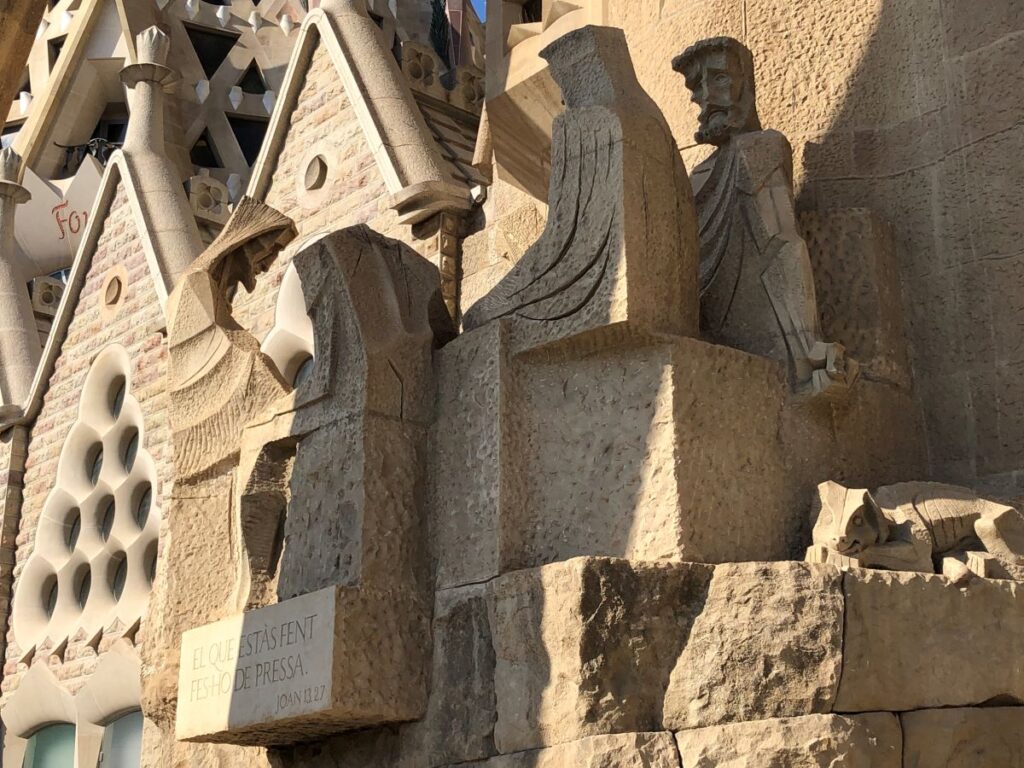
🔤 Inscriptions and Text
Languages:
- Latin: Traditional language of the Church
- Catalan: Gaudí’s and Subirachs’ native language
- Greek: Occasionally, for theological terms
Key Phrases to Find:
Latin:
- “Ecce Homo” (Behold the Man – Pilate presenting Christ)
- “Tenebrae factae sunt” (Darkness came over the land)
- “Consummatum est” (It is finished – Christ’s last words)
Catalan:
- “Passió” (Passion)
- “Resurrecció” (Resurrection)
- “Esperança” (Hope)
Numerical Inscriptions:
- References to 33 throughout
- Biblical chapter/verse citations
Rosary Beads:
- Carved stone rosary appears subtly
- Connects the Passion to Marian devotion
- Reminder of prayer in suffering
Chapter 4: Subirachs’ Sculptural Style – Modernism Meets Sacred Narrative
🎨 Understanding Subirachs’ Artistic Choices
Josep Maria Subirachs did not imitate Gaudí’s organic naturalism. Instead, he developed a style that complemented the Passion Façade’s architectural intent.
Key Characteristics of Subirachs’ Sculpture:
1. Angular, Geometric Forms
- Figures are abstracted into planes and angles
- Human forms feel carved by force, not grown by nature
- Creates visual tension that echoes emotional tension
Why This Works:
- Matches the façade’s skeletal architecture
- Emphasizes the harshness of the Passion narrative
- Avoids sentimental realism; focuses on emotional truth
2. Expressionist Abstraction
- Faces are simplified; emotion is conveyed through posture and form
- Details are omitted to focus on essential meaning
- Negative space is as important as solid form
Effect:
- Viewers project their own emotions onto the ambiguous forms
- The sculptures feel timeless, not tied to a specific historical style
- The abstraction invites contemplation rather than mere observation
3. Minimal Detail, Maximum Impact
- Subirachs uses restraint: a few carefully placed details convey volumes
- Hands, faces, and gestures are simplified but powerful
- Ornament is avoided; the form itself carries meaning
Philosophy:
“Less is more when the subject is suffering. Decoration distracts from the message.” — Subirachs (paraphrased)
4. Material Contrast
- Primarily stone, but bronze used for key moments (e.g., Kiss of Judas)
- Different textures create visual interest without ornament
- Bronze figures stand out against stone, emphasizing their narrative importance
🗣️ The Controversy: Did Subirachs Betray Gaudí?
When Subirachs’ work was first revealed, it sparked debate:
Critics Argued:
- The modernist style clashed with Gaudí’s organic aesthetic
- The abstraction lacked the warmth and detail of Gaudí’s work
- The façade felt cold compared to the Nativity’s abundance
Supporters Responded:
- Subirachs faithfully interpreted Gaudí’s vision of austerity
- Imitation would have been dishonest; contrast was the point
- The emotional power of the sculptures honors Gaudí’s intent
The Verdict of Time: Today, most scholars and visitors recognize that Subirachs’ work, while different in style, is faithful to Gaudí’s theological and artistic vision. The contrast between the two façades is not a flaw—it is the point.
**Gaudí’s Own Words **(Paraphrased)
“Do not copy me. Understand what I was trying to say, and say it in your own voice.”
Subirachs did exactly that.
🔍 Subirachs’ Hidden Signatures
Like many artists, Subirachs included subtle personal touches:
His Initials:
- “S” and “JMS” appear in small carvings
- A humble signature, not ostentatious
The Date 1987:
- When he began work on the project
- Carved subtly into a corner
Catalan Symbols:
- References to Catalan culture and identity
- A nod to Gaudí’s own Catalan pride
Tourist Tip: Look closely at the base of sculptures and in corners—you might spot these hidden details.
Chapter 5: Hidden Details – What Most Tourists Miss
The Passion Façade rewards careful observation. While most visitors photograph the grand Crucifixion scene, the smallest details often hold the deepest meaning. Here’s your treasure hunt guide:
🔢 The Magic Square (Revisited)
Location: Glory Portal, high on the façade near the Kiss of Judas
What to Do:
- Bring binoculars or zoom with your camera
- Count the rows, columns, diagonals—they all add to 33
- Notice the two central 10s; the symmetry is intentional
Why It Matters: A hidden mathematical perfection underlying the narrative of suffering—divine order in apparent chaos.
🗝️ The Key of Saint Peter
Location: Near the Last Supper scenes
Symbolism:
- Peter was given the “keys to the kingdom” (Matthew 16:19)
- Despite his denial, he is forgiven and entrusted with leadership
- Symbol of mercy and restoration
Detail: The key is subtly carved, easy to miss among the larger figures.
🕊️ The Dove of Peace
Location: Near the Resurrection scenes
Symbolism:
- Holy Spirit
- Peace after suffering
- Hope rising from despair
Detail: The dove is small and stylized; look for it in the upper sections.
🌑 The Shadow Play
Not a Sculpture, but Essential: The Passion Façade is designed for afternoon light, when the sun rakes across its angular surfaces.
What to Notice:
- How shadows deepen the emotional impact
- How certain details emerge only at specific times
- How the façade changes throughout the day
Pro Tip: Visit between 3:00-5:30 PM for the most dramatic light.
✍️ Subirachs’ Signature Gesture
Location: On the arm of one of the Marys at the Crucifixion
Detail: A small, stylized hand gesture that appears in other Subirachs works—a personal artistic signature.
Why It Matters: A reminder that this is the work of a specific artist, interpreting Gaudí’s vision through his own voice.
📜 The Small Inscriptions
Location: Scattered throughout the façade
Texts to Find:
- Biblical verse references (e.g., “Mt 27:45” for the darkness at crucifixion)
- Catalan words for “suffering,” “hope,” “love”
- Numerical references to 33
Tip: Bring a small notebook to jot down inscriptions you want to research later.
🪨 The Texture Variations
Observation Exercise: Run your eyes (not your hands—please don’t touch!) over the stone surfaces.
What to Notice:
- Some areas are smooth; others are rough
- Tool marks are visible in places
- The variation is intentional: different textures convey different emotions
Symbolic Meaning:
- Smooth = peace, resolution
- Rough = struggle, pain
- The façade itself is a text to be “read” through touch (visually)
🔥 The Flame Motif
Location: Near the Resurrection scenes
Symbolism:
- The Holy Spirit as fire (Acts 2:3)
- Purification through suffering
- Light emerging from darkness
Detail: Stylized flames carved in low relief; easy to overlook.
🧭 The Directional Symbolism
East vs. West:
- Nativity Façade (east): sunrise, birth, beginning
- Passion Façade (west): sunset, death, ending (but also promise of new dawn)
What to Notice:
- How the west-facing orientation affects light and shadow
- How the façade feels different in morning vs. afternoon light
- The theological significance of direction in Christian architecture
Chapter 6: Photography Guide – Capturing the Drama of Suffering
🌅 Best Times for Photography
The Passion Façade faces west, which dramatically affects your photography options:
🌞 Afternoon Light (3:00 PM – 6:00 PM) ⭐ BEST
Advantages:
- Direct sunlight rakes across the angular surfaces
- Deep shadows emphasize sculptural relief and emotional tension
- Warm, golden tones enhance the stone’s color
- Dramatic contrast perfect for black-and-white conversion
- Fewer crowds in late afternoon
Best For:
- Overall façade shots with dramatic shadows
- Detail photography emphasizing texture and form
- Silhouettes against the glowing stone
- Black-and-white conversions (the façade is naturally high-contrast)
Settings:
- Aperture: f/8-f/11 for sharpness across the façade
- ISO: 200-400 (afternoon light is bright)
- Shutter: 1/250s or faster to freeze detail
- White balance: Daylight or cloudy (enhances warmth)
- Consider exposure compensation: -0.3 to -1.0 EV to protect highlights
🌆 Golden Hour (1 hour before sunset)
Magic Time:
- Low-angle light creates long, dramatic shadows
- Warm tones intensify the stone’s color
- The façade feels almost alive with light and shadow
- Perfect for emotional, atmospheric shots
Settings:
- Aperture: f/5.6-f/8
- ISO: 400-800 (light is fading)
- Shutter: 1/125s or faster (use image stabilization)
- White balance: Cloudy or shade (enhances warmth)
- Bracket exposures for HDR if desired
🌃 Blue Hour (After Sunset)
Dramatic Alternative:
- Façade illuminated by artificial lights
- Deep blue sky creates striking contrast
- Fewer tourists; more contemplative atmosphere
- Artificial lighting emphasizes different details than sunlight
Settings:
- Tripod essential
- Aperture: f/8-f/11
- ISO: 800-1600
- Shutter: 1-4 seconds
- White balance: Tungsten or daylight (experiment)
- Long exposure can blur moving clouds for added drama
🌤️ Morning Light (Avoid for This Façade)
Why It’s Challenging:
- Façade is in shadow
- Flat, even light reduces dramatic impact
- Shadows that emphasize form are absent
If You Must Shoot in Morning:
- Focus on details rather than overall composition
- Use black-and-white to emphasize form over light
- Look for reflected light from surrounding buildings
📐 Best Angles and Compositions
Angle 1: Straight-On from Carrer de Sardenya
Location: Street directly in front of the façade
What You Get:
- Full façade in frame
- Symmetrical composition emphasizing the central Crucifixion
- Context of surrounding Eixample architecture
- Classic documentary shot
Tips:
- Use wide-angle lens (16-35mm)
- Arrive in afternoon for best light
- Include street elements for urban context
- Consider vertical orientation to emphasize height
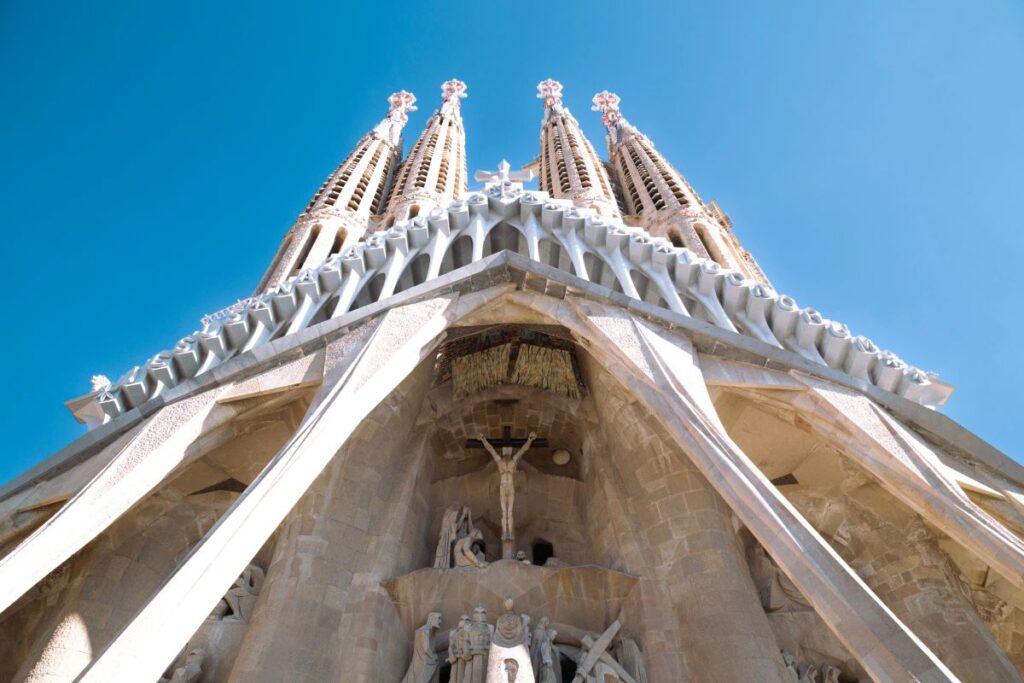
Angle 2: Low Angle from Base
Location: Standing at the foot of the façade
What You Get:
- Dramatic upward perspective
- Emphasizes the skeletal, imposing nature of the architecture
- Towers appear to pierce the sky
- Sense of awe and intimidation (intentional)
Tips:
- Ultra-wide lens (14-24mm)
- Include people for scale (emphasizes monumentality)
- Watch for distortion; correct in post if needed
- Best in afternoon light for shadow drama
Angle 3: Detail Close-Ups
Location: Move along the façade, focusing on specific sculptural groups
What You Get:
- Subirachs’ expressive figures
- Textural studies of stone
- Symbolic elements (Magic Square, inscriptions, etc.)
- Unique, intimate perspectives
Tips:
- Telephoto lens (70-200mm) or macro
- Shallow depth of field (f/2.8-f/4) for subject isolation
- Focus on eyes or hands of figures for emotional impact
- Look for patterns: repetition of angles, play of light and shadow
Angle 4: Oblique from the Side
Location: Corner of Carrer de Sardenya and Carrer de Provença
What You Get:
- Three-dimensional perspective showing depth
- Side view of portals reveals sculptural layering
- Towers in profile
- Less common, more artistic angle
Tips:
- Standard lens (35-50mm)
- Afternoon light creates dramatic side shadows
- Include architectural context of surrounding buildings
- Good for storytelling compositions
Angle 5: From Tower Access
Location: Inside the Passion towers (requires tower ticket)
What You Get:
- Bird’s-eye view of façade details
- Unique downward perspective on sculptural groups
- Close-up of angular architectural elements
- Behind-the-scenes feel
Tips:
- Wide-angle for context
- Careful with narrow spaces; no tripods allowed
- Respect other visitors; be quick and unobtrusive
- Focus on details impossible to see from ground level
🎨 Composition Techniques for the Passion Façade
Rule of Thirds:
- Place the Crucifixion group on a third line
- Position the Magic Square at an intersection point
- Creates dynamic, balanced composition
Leading Lines:
- Use the sharp angles of columns to guide the eye
- Follow the lines of arches toward the central scene
- Creates visual tension that mirrors emotional tension
Framing:
- Use angular arches to frame sculptural groups
- Create natural borders with architectural elements
- Adds depth and focuses attention
Symmetry and Asymmetry:
- The façade is roughly symmetrical, but Subirachs’ sculptures introduce intentional asymmetry
- Play with both: center for formal impact; off-center for dynamic tension
Contrast:
- Light vs. shadow is the façade’s native language
- Emphasize contrast in post-processing
- Black-and-white conversion often enhances the dramatic impact
Negative Space:
- The Passion Façade uses emptiness expressively
- Don’t feel compelled to fill the frame
- Let bare stone and shadow carry meaning
📱 Smartphone Photography Tips
iPhone Tips:
- Use Portrait mode for detail shots (creates pleasing background blur)
- Enable Smart HDR for high-contrast scenes (common on this façade)
- Tap to focus on sculptural details, then slide to adjust exposure
- Use Night mode for blue hour shots (hold steady or use mini-tripod)
- Shoot in ProRAW if available for maximum editing flexibility
Android Tips:
- Use Pro mode for manual control of exposure and focus
- Enable HDR+ for balanced exposure in high-contrast scenes
- Tap to focus and adjust exposure; lock AE/AF for consistency
- Use Night Sight for low-light blue hour photography
- Shoot in RAW if available for post-processing flexibility
Universal Tips:
- Clean your lens before shooting (dust and fingerprints reduce sharpness)
- Use grid lines for composition (enable in camera settings)
- Tap and hold to lock focus/exposure for consistent shots
- Use volume buttons as shutter release (reduces camera shake)
- Edit in Lightroom Mobile or Snapseed for professional results
Black-and-White Conversion: The Passion Façade is naturally suited to monochrome:
- High contrast between light and shadow
- Angular forms read powerfully without color
- Emotional impact is enhanced by the timeless quality of B&W
Mobile Workflow:
- Shoot in color (gives more editing options)
- Convert to B&W in post (Lightroom Mobile, Snapseed, VSCO)
- Adjust contrast and clarity to emphasize form
- Consider a slight vignette to focus attention on central elements
Chapter 7: Visiting the Passion Façade – Practical Information
📍 Location and Access
Address:
Carrer de Sardenya, s/n
08013 Barcelona, Spain
Best Viewing Location:
Carrer de Sardenya – the street directly in front of the façade, or the small plaza at the intersection with Carrer de Provença
How to Get There:
By Metro:
- **L2 **(Purple) or **L5 **(Blue) to Sagrada Família station
- Exit toward Carrer de Sardenya
- 2-minute walk to façade
By Bus:
- Routes: 19, 33, 34, 43, 44, 50, 51, H10
- Stop: “Sagrada Família” or “Sardenya – Provença”
- 1-2 minute walk
By Taxi/Rideshare:
- Drop-off at Carrer de Sardenya or Carrer de Provença
- Most direct option; specify “Passion Façade entrance”
Walking:
- From Passeig de Gràcia: 15 minutes
- From Gothic Quarter: 25 minutes
- From Park Güell: 20 minutes (mostly downhill)
⏰ Best Times to Visit
For Photography:
- **Afternoon **(3:00-5:30 PM): Best light for dramatic shadows and warm tones
- **Golden hour **(1 hour before sunset): Magical, emotional atmosphere
- **Blue hour **(after sunset): Striking contrast between illuminated façade and dark sky
For Contemplation:
- Weekday afternoons: Quieter than mornings; fewer tour groups
- Late afternoon: Crowds thinning; more space for reflection
- Avoid Sundays during Mass: The façade is near the main entrance; worship takes priority
To Avoid:
- **Mid-morning **(10:00 AM-12:00 PM): Peak crowds; façade in shadow
- Weekends: Busier with locals and tourists
- Holy Week: Extremely crowded; consider visiting another time for contemplation
🎫 Viewing Options
Free Exterior Viewing:
- You can admire the Passion Façade from the street without a ticket
- Perfect for photography and initial appreciation
- No access to interior or towers
**Interior Visit **(Requires Ticket)
- See the connection between Passion Façade and interior
- Understand how the exterior symbolism continues inside
- Access to museum with Gaudí’s models and Subirachs’ sketches
- Ticket required: Book in advance at sagradafamilia.org
**Tower Access **(Requires Upgrade)
- Elevator to Passion towers
- Close-up views of façade details and sculptural elements
- Panoramic Barcelona views from the west side
- Spiral staircase descent
- Additional fee: Book when purchasing tickets
- Not wheelchair accessible
♿ Accessibility
Exterior Viewing:
- Fully accessible from street level
- Smooth sidewalks on Carrer de Sardenya
- Benches nearby for resting
- Accessible restrooms in surrounding area
Interior:
- Wheelchair accessible
- Elevators to all levels (except towers)
- Accessible restrooms
- Wheelchair loan available (reserve ahead)
Towers:
- NOT accessible – spiral stairs required for descent
- No elevator down
- Not recommended for mobility issues, claustrophobia, or young children
🕐 Recommended Visit Duration
Exterior Only: 20-30 minutes
Exterior + Interior: 1.5-2 hours
**Full Experience **(exterior, interior, towers, museum) 2.5-3 hours
📱 Audio Guide and Tours
Official Audio Guide:
- Included with most tickets
- Available in 10+ languages
- Detailed explanation of Passion Façade symbolism and Subirachs’ work
- Download app before arrival
Guided Tours:
- Expert commentary on theological and artistic context
- Skip-the-line access
- Deeper exploration of Subirachs’ sculptures and Gaudí’s vision
- Additional cost (~€15-25)
- Book in advance; specify interest in Passion Façade
Chapter 8: The Passion Façade in Context – Comparing the Three Façades
The Sagrada Família has three grand façades, each with distinct character and purpose. Understanding their differences enhances your appreciation of the Passion Façade.
🔄 The Three Façades Compared
| Feature | Nativity Façade | Passion Façade | Glory Façade |
|---|---|---|---|
| Direction | East (sunrise) | West (sunset) | South (main entrance) |
| Theme | Birth, life, joy | Death, suffering, sacrifice | Resurrection, glory, eternal life |
| Style | Ornate, organic, naturalistic | Stark, angular, skeletal | Grand, monumental (under construction) |
| Gaudí’s Involvement | Designed & mostly completed | Designed, built after his death | Designed, under construction |
| Completion Date | ~1930 | 1976 (structure), 2009 (sculpture) | Estimated 2030+ |
| Sculptor | Gaudí’s workshop | Josep Maria Subirachs | Various contemporary artists |
| Mood | Celebratory, hopeful, abundant | Somber, dramatic, austere | Triumphant, universal, cosmic |
| Decoration | Maximum density | Minimal, bare stone | Will be elaborate |
| Symbolism | Life, nature, hope | Death, sacrifice, redemption | Glory, heaven, humanity’s path to God |
🎭 The Theological Journey
The three façades create a spiritual narrative:
- **Nativity **(East): Birth and incarnation – God becomes human
- **Passion **(West): Death and redemption – Human suffering and divine sacrifice
- **Glory **(South): Resurrection and eternal life – Humanity’s ultimate destiny
Walking the Path: As you move from the Nativity Façade around to the Passion Façade, you experience the full story of Christ—from the joy of birth to the agony of the cross. The Glory Façade (when completed) will complete the journey with the promise of resurrection.
🎨 Artistic Contrast: Nativity vs. Passion
The contrast is intentional and dramatic:
Nativity:
- Curves, organic forms
- Abundant decoration
- Natural elements everywhere
- Warm, inviting
- Celebrates creation
Passion:
- Straight lines, sharp angles
- Bare, skeletal structure
- Minimal ornamentation
- Stark, challenging
- Confronts suffering
Gaudí’s Intent:
“The Nativity Façade is life, joy, abundance. The Passion Façade is death, sacrifice, austerity. Both are necessary. One without the other is incomplete.”
This contrast teaches that Christian faith embraces both joy and suffering, birth and death, hope and sacrifice.
Subirachs’ Contribution: By choosing a modernist, expressionist style rather than imitating Gaudí’s organic naturalism, Subirachs honored the spirit of Gaudí’s vision: contrast, not imitation.
Chapter 9: Preservation and Conservation – Protecting a Modern Masterpiece
🏛️ The Challenge of Time
The Passion Façade is a relatively recent completion (sculpture finished in 2009), but it faces the same conservation challenges as the older Nativity Façade.
Threats to the Façade:
- Weathering:
- Rain erosion on angular surfaces
- Temperature fluctuations causing expansion/contraction
- Salt crystallization from sea air
- Pollution:
- Acid rain damaging stone
- Particulate matter blackening surfaces
- Chemical reactions with stone minerals
- Biological Growth:
- Lichen and moss in recessed areas
- Plant roots in cracks
- Bird droppings (acidic)
- Human Impact:
- Touching and handling (oils from skin)
- Vibration from tourism
- Flash photography (minimal but cumulative)
🔧 Conservation Efforts
Ongoing Work:
Stone Cleaning:
- Gentle methods to remove pollutants
- Laser cleaning for delicate sculptural details
- Chemical poultices for stubborn deposits
- Never abrasive methods that damage Subirachs’ precise carving
Structural Monitoring:
- 3D laser scanning to detect movement
- Sensors measuring stress and vibration
- Regular inspections by structural engineers
- Immediate repair of cracks or instability
Sculpture Restoration:
- Expert stone carvers repair damaged elements
- Use same Montjuïc sandstone when possible
- Document every intervention
- Reversible methods when feasible
Protective Measures:
- Limiting direct touching
- Controlling visitor flow
- Installing protective barriers where needed
- Climate monitoring
🌱 Sustainable Tourism
Balancing Access and Preservation:
The Sagrada Família Foundation faces the challenge of allowing millions to experience Subirachs’ work while protecting it for future generations.
Strategies:
- Timed Entry: Controls crowd density
- Designated Pathways: Prevents wear on sensitive areas
- Education: Informing visitors about preservation
- Funding: Ticket sales directly fund conservation
- Research: Ongoing study of materials and methods
Your Role as a Visitor:
✅ Do:
- Follow all posted guidelines
- Stay on designated paths
- Don’t touch sculptures (oils damage stone)
- Report damage to staff
- Respect the space
❌ Don’t:
- Climb on any elements
- Touch carvings (skin oils damage stone)
- Leave trash or graffiti
- Use flash photography
- Ignore staff instructions
💰 Funding Conservation
Where Your Ticket Money Goes:
The Sagrada Família receives no government funding. All construction and conservation costs come from:
- Ticket sales (~80%)
- Private donations (~15%)
- Merchandise and publications (~5%)
Your visit directly funds:
- Ongoing construction of the Glory Façade
- Conservation of completed sections (Nativity and Passion)
- Research and documentation
- Educational programs
- Staff salaries
This makes you a patron—contributing to the continuation of Gaudí’s and Subirachs’ vision.
Chapter 10: Frequently Asked Questions – Passion Façade
❓ Why does the Passion Façade look so different from the Nativity Façade?
A: The contrast is intentional. Gaudí designed the Nativity Façade to celebrate birth, life, and joy—so it’s ornate and abundant. He designed the Passion Façade to depict suffering and sacrifice—so it’s stark and austere. This theological duality teaches that faith embraces both joy and sorrow.
❓ Who sculpted the Passion Façade figures?
A: Catalan sculptor Josep Maria Subirachs (1927-2014) created the sculptural program between 1987-2009. He chose a modernist, expressionist style that complemented Gaudí’s vision of austerity rather than imitating Gaudí’s organic naturalism.
❓ What is the Magic Square and why does it add to 33?
A: The Magic Square is a 4×4 grid of numbers where every row, column, diagonal, and many other groupings add to 33—the traditional age of Christ at his crucifixion. It’s a hidden numerological puzzle symbolizing divine order underlying the narrative of suffering.
❓ Can I touch the sculptures?
A: No. The oils and acids from human skin damage the stone over time. With millions of visitors, even gentle touching causes cumulative harm. Please admire with your eyes, not your hands.
❓ What’s the best time of day to photograph the Passion Façade?
A: **Afternoon **(3:00-5:30 PM) when direct sunlight rakes across the west-facing façade, creating dramatic shadows that emphasize the angular forms. Golden hour (1 hour before sunset) is also spectacular for warm, emotional shots.
❓ Are the towers safe to visit?
A: Yes, with precautions. The towers are structurally sound and regularly inspected. However:
- Not suitable for those with mobility issues, claustrophobia, or heart conditions
- Children must be supervised
- Follow all safety instructions
- Hold handrails on spiral staircase
- No tripods or large bags
❓ Why did Subirachs use such a different style from Gaudí?
A: Subirachs believed that imitating Gaudí’s style would have betrayed Gaudí’s intent. Gaudí wanted the Passion Façade to feel stark and austere; Subirachs’ angular, expressionist style achieves that emotional impact. Contrast, not imitation, was the goal.
❓ Can I visit just the Passion Façade without entering the basilica?
A: Yes! You can admire the exterior from Carrer de Sardenya and surrounding streets for free without a ticket. However, to understand the full symbolism and see how it connects to the interior, entering the basilica is highly recommended.
❓ What language are the inscriptions in?
A: Primarily Latin (traditional language of the Catholic Church) and Catalan (Gaudí’s and Subirachs’ native language). You’ll find phrases like “Ecce Homo” (Latin) and “Passió” (Catalan).
❓ Is the Passion Façade complete?
A: Yes. The structural work was completed in 1976, and Subirachs’ sculptural program was finished in 2009. While minor conservation work continues, the façade as Gaudí envisioned it is complete.
❓ What’s the significance of the west-facing orientation?
A: The west is traditionally associated with sunset, ending, and death in Christian symbolism. By facing the Passion Façade west, Gaudí connected the architecture to the theological theme: Christ’s death as the “sunset” that precedes the “sunrise” of resurrection.
❓ Can I propose or have a wedding at the Passion Façade?
A: Private events require advance permission and are generally not permitted during regular visiting hours. The basilica does host weddings, but they must be arranged through the Sagrada Família Foundation well in advance. Casual proposals in public areas are tolerated if brief and respectful.
Chapter 11: Your Passion Façade Visit Checklist
✅ Before You Go
Research & Planning:
- Read about the symbolism (you’re doing this now!)
- Watch documentaries about Subirachs and the Passion Façade
- Download the official Sagrada Família app
- Book tickets in advance (especially for tower access)
- Check weather forecast (afternoon sun is ideal)
- Plan arrival time (3:00-4:00 PM recommended)
What to Bring:
- Comfortable walking shoes
- Camera or smartphone (fully charged)
- Portable battery/charger
- Water bottle
- Sunscreen and hat (for afternoon exterior viewing)
- Light scarf or shawl (for interior visit – dress code)
- Small notebook for sketching or notes
- Binoculars (optional, for seeing high details like the Magic Square)
What to Leave Behind:
- Large backpacks or luggage (no storage on-site)
- Food and drinks (not permitted inside)
- Tripods (discouraged during peak hours)
- Selfie sticks (prohibited inside)
- Flash photography equipment
✅ Day Of Visit
Afternoon Preparation:
- Dress appropriately (shoulders and knees covered for interior)
- Eat lunch beforehand (no food inside basilica)
- Charge all devices overnight
- Screenshot ticket QR code as backup
- Set phone alarms for departure time
- Check real-time metro/bus schedules
On Arrival:
- Arrive 20-25 minutes before timed entry
- Start at Carrer de Sardenya for exterior viewing
- Photograph façade in afternoon light
- Note details you want to see up close (Magic Square, inscriptions)
- Pass through security screening
- Validate ticket at turnstiles
- Download/access audio guide
- Begin with Passion Façade interior connection
✅ While Viewing the Façade
Exterior Checklist:
- Overall view from Carrer de Sardenya
- Central Portal: Crucifixion scene
- Left Portal: Last Supper, Kiss of Judas
- Right Portal: Resurrection, Ascension
- Magic Square: Find it and verify the 33 pattern
- Subirachs’ angular sculptures: Observe the style
- Inscriptions: Latin and Catalan text
- Shadow play: Notice how light emphasizes form
- Hidden details: Key of Peter, dove, flame motifs
Interior Connection:
- See how Passion Façade connects to nave
- Notice light from west windows (warm reds/oranges)
- Compare exterior sculpture to interior columns
- Visit museum to see Subirachs’ sketches and models
- Read about the contrast with Nativity Façade
Photography Goals:
- Wide shot of entire façade in afternoon light
- Detail shots of key sculptures (Crucifixion, Kiss of Judas)
- Low-angle dramatic perspective
- Close-ups of Magic Square and inscriptions
- Tower details and angular architecture
- Shadow studies emphasizing form
- Black-and-white conversion for dramatic impact
✅ After Your Visit
Reflection:
- Review photos and note favorites
- Sketch or journal about what moved you
- Research symbols you want to understand better
- Share respectful photos on social media
- Leave a review to help other visitors
Next Steps:
- Visit the Nativity Façade for contrast
- Explore the interior to see how the façades connect
- Read more about Subirachs and modern religious art
- Consider returning at blue hour for different lighting
- Support the foundation through donations if moved
Suffering Transformed by Love
The Passion Façade is more than architecture. It is Antoni Gaudí’s meditation on sacrifice carved in stone—a testament to his belief that suffering, when embraced with love, becomes redemptive.
When you stand before it, you’re not just looking at a building. You’re witnessing a visual sermon: stark, angular, unflinching. You’re seeing Josep Maria Subirachs’ interpretation of Gaudí’s vision—modern, expressionist, powerful. You’re reading a story written not in words but in form, light, and shadow.
Gaudí knew he would not live to see this façade completed. He entrusted his vision to the future, to artists who would understand that faithfulness doesn’t mean imitation—it means capturing the spirit in a new voice.
Today, as you walk around it, photograph it, study its details, you join the millions who have been moved by this powerful expression of Christian faith. You become part of the story—a story that acknowledges suffering but does not end there.
So take your time. Look closely. Notice the Magic Square adding to 33, the angular Christ on the cross, the subtle dove of hope. Let the stark beauty of this façade remind you that even in suffering, there is meaning; even in death, there is promise.
And when you finally turn away, the façade will remain—as it has since 2009—facing west toward the setting sun, a meditation on sacrifice that points toward the dawn of resurrection.
That is the gift of the Passion Façade. That is Gaudí’s and Subirachs’ legacy. And now, it is yours to carry forward.