Introduction: Witnessing History in the Making
There are ancient wonders, and then there is the 사그라다 파밀리아. While the Pyramids were built in decades and Gothic cathedrals in centuries, the Sagrada Família occupies a unique space in human history: a masterpiece under construction for over 140 years, bridging three centuries (19th, 20th, and 21st).
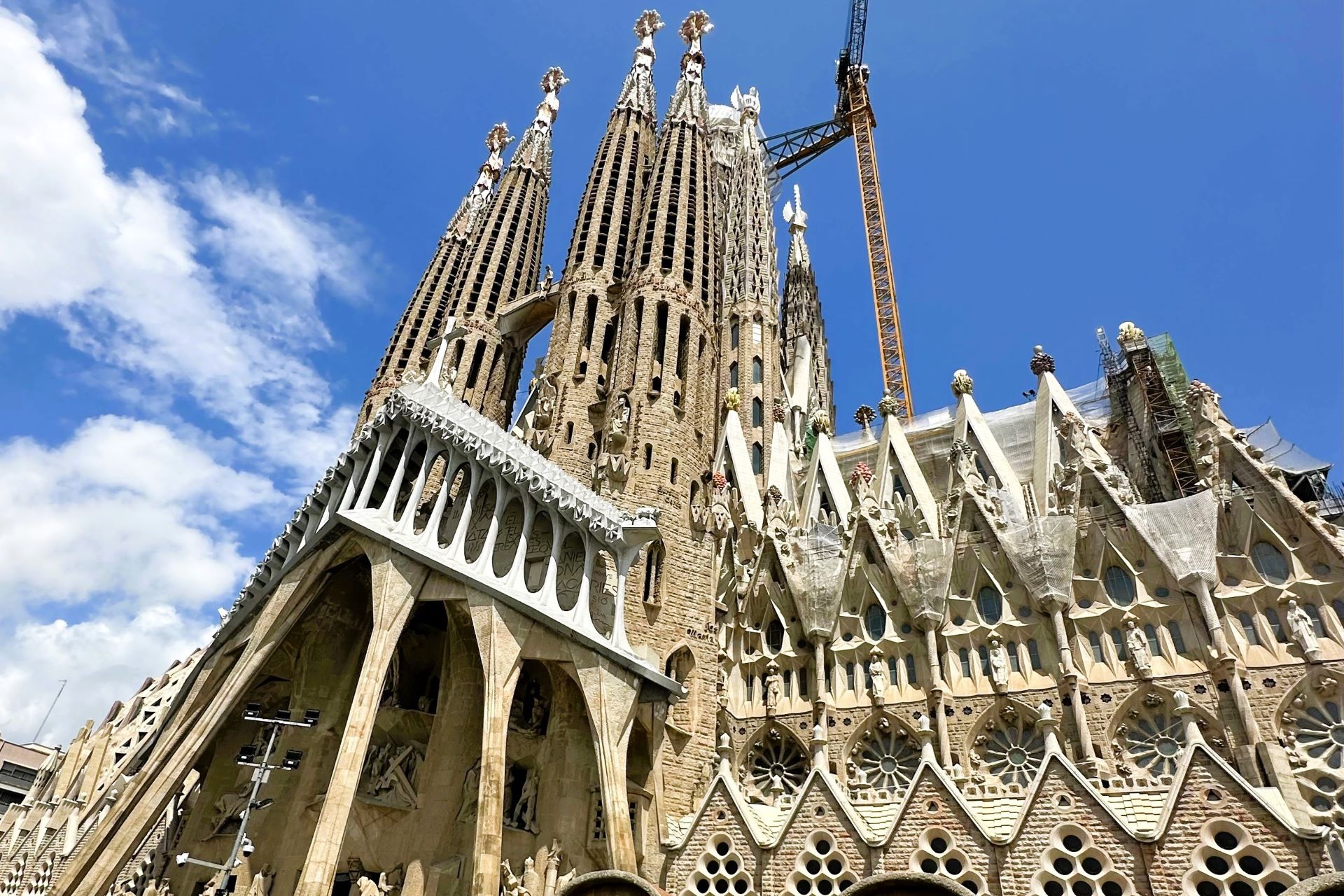
For tourists, this isn’t just a static monument. It is a living construction site. The cranes you see against the Barcelona sky aren’t eyesores; they are symbols of continuity. Every stone placed today connects back to Antoni Gaudí’s vision in 1883, yet utilizes technology he could never have imagined.
Understanding the construction milestones of Sagrada Família transforms your visit. When you stand beneath the nave, you aren’t just seeing a roof; you’re seeing a structure completed in 1990 using 19th-century concepts. When you touch the Nativity Facade, you’re touching stone carved during Gaudí’s lifetime.
This guide breaks down the key construction dates and progress markers of the Sagrada Família. We’ll walk you through the timeline, explain the technological shifts, and highlight exactly what to look for during your tour to spot these historical layers.
Chapter 1: The Foundation Era (1882-1883)
📅 Milestone: Construction Begins
Date: 1882년 9월 18일
Status: Completed
Architect: 프란시스코 데 파울라 델 비야르
The story begins not with Gaudí, but with Villar. The original design was a standard 신고딕 양식 교회. The first stone was laid under the crypt where the high altar stands today.
👀 Tourist Takeaway: Where to See It
- 크립트: Descend to the lower level. The crypt reflects Villar’s original neo-Gothic style, which is more traditional and less organic than the upper church.
- The Foundation Stone: Look for the plaque marking the 1882 start date near the entrance.
📅 Milestone: Gaudí Takes Over
Date: 1883년 11월
Status: Completed
Architect: 안토니 가우디
Just one year later, Villar resigned due to disagreements. Gaudí, then 31, took charge. He didn’t just continue the work; he revolutionized it. He kept the crypt but redesigned everything above ground to reflect his nature-inspired philosophy.
👀 Tourist Takeaway: The Shift in Style
- Compare the Crypt (Villar) with the Nave (Gaudí). Notice the transition from sharp Gothic arches to branching, tree-like columns. This is the physical manifestation of the 1883 milestone.
Chapter 2: Gaudí’s Lifetime Work (1883-1926)
📅 Milestone: Completion of the Crypt
Date: 1891
Status: Completed
Significance: The spiritual foundation of the basilica.
Before building upward, Gaudí ensured the base was solid. The crypt was finished and consecrated, allowing religious services to begin even as construction rumbled above.
📅 Milestone: Nativity Facade Construction Begins
Date: 1892
Status: Completed (during Gaudí’s life)
Significance: The only facade Gaudí saw substantially finished.
Gaudí prioritized the 예수 탄생 파사드 (east side) because he knew he might not live to see the whole church done. He wanted to leave a completed example for future architects to follow.
👀 Tourist Takeaway: Gaudí’s Hand
- 외부: Walk to the Carrer de la Marina side. The intricate stone carvings of plants, animals, and biblical scenes were directed by Gaudí himself.
- Detail: Look for the “Tree of Life” sculpture. The organic fluidity here is pure Gaudí, unlike the starker Passion Facade built later.
📅 Milestone: The Sagrada Família School Built
Date: 1909
Status: Standing (Relocated)
Significance: A small brick building for workers’ children.
Gaudí designed a small school on the site for the children of construction workers. It showcased his ability to create beauty with simple materials (brick) and minimal budget.
👀 Tourist Takeaway: The School Building
- Located on the Passion Facade side (Carrer de Sardenya). It’s a small, wavy brick structure. It’s often overlooked but represents Gaudí’s social conscience.
📅 Milestone: Gaudí’s Death
Date: 1926년 6월 10일
Status: Historical Turning Point
Significance: Only the Nativity Facade and one tower were complete.
When Gaudí died, less than 25% of the project was done. He left behind models, plans, and sketches. The construction team faced the daunting task of continuing his vision without his direct guidance.
👀 Tourist Takeaway: Gaudí’s Tomb
- 크립트: Visit the tomb of Antoni Gaudí. It’s a simple marker in the floor, reminding visitors that the architect is part of the foundation he built.
Chapter 3: War, Destruction & Recovery (1926-1950)
📅 Milestone: Spanish Civil War Destruction
Date: July 1936
Status: Catastrophic Loss
Significance: Gaudí’s models and plans were destroyed.
Anarchist revolutionaries broke into the workshop, smashing Gaudí’s intricate plaster models and burning his drawings. This set construction back decades. Architects had to piece together fragments of the models to understand his structural logic.
👀 Tourist Takeaway: The Museum
- Basement Museum: Look for the reconstructed fragments of Gaudí’s models. You’ll see broken plaster pieces that were salvaged from the debris. This is physical evidence of the 1936 destruction.
📅 Milestone: Construction Resumes
Date: 1940s
Status: Slow Progress
Significance: Post-war recovery.
After the Civil War and WWII, materials and funds were scarce. Work restarted slowly, focusing on stabilizing the existing structure and interpreting Gaudí’s notes for the next phase.
Chapter 4: The Passion Facade & Nave (1950-1990)
📅 Milestone: Passion Facade Construction Begins
Date: 1954
Status: Completed 1976 (Structure)
Significance: A stylistic shift to reflect suffering.
Architects decided to build the 열정의 외관 (west side) next. Unlike the ornate Nativity Facade, this was designed to be stark and angular to reflect the suffering of Christ. This decision sparked debate but followed Gaudí’s symbolic plan.
👀 Tourist Takeaway: Contrast in Stone
- Walk Around the Building: Stand between the Nativity (East) and Passion (West) facades. The contrast is jarring by design. The Passion Facade looks like it’s carved from bone; the Nativity looks like it’s grown from the earth.
📅 Milestone: Subirachs Sculptures Installed
Date: 1987-2009
Status: Completed
Significance: Modern art meets historic architecture.
Sculptor Josep Maria Subirachs created the modernist figures for the Passion Facade. His style is abstract and angular, differing from Gaudí’s naturalism but respecting the facade’s intent.
👀 Tourist Takeaway: The Magic Square
- Passion Facade: Look for the “Magic Square” on the Glory Portal. The numbers in any row, column, or diagonal add up to 33 (the age of Christ at his death). It’s a hidden mathematical milestone.
📅 Milestone: Nave Vaulting Completed
Date: 1990
Status: Completed
Significance: The interior roof was finally closed.
For over a century, the interior was open to the elements in sections. In 1990, the vaults covering the main nave were finished, allowing the interior to be fully enclosed and climate-controlled.
👀 Tourist Takeaway: Look Up
- The Ceiling: The intricate geometric patterns overhead were finalized during this period. Notice how the columns branch out to meet the vaults—this engineering was perfected in the late 20th century.
Chapter 5: The Digital Age & Acceleration (1990-Present)
📅 Milestone: Introduction of CAD & 3D Design
Date: Early 1990s
Status: Ongoing
Significance: Technology revolutionized construction speed.
Architects began using Computer-Aided Design (CAD) and stereophotogrammetry to analyze Gaudí’s surviving models. This allowed them to calculate loads and shapes with precision impossible in Gaudí’s time.
👀 Tourist Takeaway: Precision Stones
- Stone Joints: Look closely at the newer stone sections (especially on the towers). The joints are incredibly tight. This precision is due to digital cutting technology introduced in this era.
📅 Milestone: Consecration by Pope Benedict XVI
Date: November 7, 2010
Status: Religious Milestone
Significance: Declared a Minor Basilica.
Once the nave was complete and the interior functional, the church was consecrated. This allowed regular Mass to be celebrated, shifting the site from purely construction to active worship + tourism.
👀 Tourist Takeaway: The Altar
- Main Altar: The canopy over the altar was part of the preparations for the 2010 consecration. It hangs suspended, symbolizing the connection between heaven and earth.
📅 Milestone: Central Towers Construction Begins
Date: 2015
Status: In Progress
Significance: The skyline changes.
The six central towers (including the Tower of Jesus Christ) began rising. These are the tallest structures, defining the final silhouette of the basilica.
👀 Tourist Takeaway: The Cranes
- Don’t Ignore the Cranes: When you see construction equipment, know that it’s likely working on the central towers. This is the current frontier of the project.
📅 Milestone: Tower of the Virgin Mary Completed
Date: 2021
Status: Completed
Significance: First of the six central towers finished.
This was a major psychological and structural milestone. It proved the technology and funding were on track for the final push.
👀 Tourist Takeaway: The Tallest Tower (So Far)
- Look for the tower topped with a star (Virgin Mary). It stands distinct from the four apostle towers on the Nativity/Passion facades.
Chapter 6: Future Milestones – The Road to Completion
📅 Target: Completion of Central Towers
Date: 2026 (Centenary of Gaudí’s Death)
Status: In Progress
Significance: Structural completion of the main profile.
The current goal is to have the six central towers finished by 2026. This includes the Tower of Jesus Christ, which will be the tallest at 172.5 meters.
⚠️ Tourist Note: While 2026 is the target for the main structure, decorative work will continue beyond this date. Don’t expect the scaffolding to vanish completely in 2026.
📅 Target: Glory Facade Completion
Date: 2030-2032 (Estimated)
Status: Planning/Early Work
Significance: The main entrance will be finished.
그만큼 글로리 파사드 (south side) is the largest and most important. It faces the city center. Its completion requires significant urban planning (potentially demolishing surrounding blocks), making it the most complex remaining milestone.
👀 Tourist Takeaway: The Main Entrance
- Currently, the Glory Facade is largely covered or incomplete. When you return in the future, this will be the grand entrance you walk through.
📅 Target: Final Decorative Elements
Date: 2032+
Status: Future
Significance: Full artistic completion.
Even after the towers are done, stone carvings, stained glass, and landscaping will continue. Like many European cathedrals, “completion” is a fluid concept.
Chapter 7: Technology Milestones – How Building Methods Changed
Understanding how it was built is as fascinating as when. Here is the technological evolution you can spot on site.
| Era | Technology | What Tourists See |
|---|---|---|
| 1880s-1920s | Hand carving, stone masonry, hanging chain models | 예수 탄생 파사드: Irregular, organic textures; unique stone pieces. |
| 1950s-1980s | Reinforced concrete, traditional casting | Passion Facade: Smoother surfaces, sharper angles, concrete structure beneath stone cladding. |
| 1990s-2010s | CAD design, diamond wire saws, CNC machines | Interior Columns: Perfectly smooth, complex geometric shapes impossible to carve by hand. |
| 2020s | 3D printing, robotic stone cutting, BIM (Building Information Modeling) | New Towers: Extremely precise joints, modular stone pieces assembled like puzzles. |
👀 Tourist Challenge: Try to spot the difference between hand-carved stone (rougher, unique) and machine-cut stone (smoother, uniform). The transition is visible as you walk around the exterior.
Chapter 8: Frequently Asked Questions – Construction & Progress
❓ Will the Sagrada Família ever truly be finished?
에이: The structural main elements (towers, facades) are targeted for completion by 2032. However, decorative stone carving and maintenance are ongoing processes, much like Cologne Cathedral or Milan Duomo.
❓ Why does construction still happen while tourists are inside?
에이: The basilica is large enough to separate zones. Safety barriers ensure tourists are never in danger. The sound of construction is part of the authentic experience—it shows the project is alive.
❓ Does my ticket money fund the construction?
에이: Yes. The Sagrada Família receives no government funding. 100% of construction costs come from ticket sales and private donations. Your visit directly places the next stone.
❓ Can I see the construction work up close?
에이: Yes! If you book 타워 접근, you will take an elevator up through the structure. You’ll see scaffolding, workers, and the unfinished sections of the towers from a unique vantage point.
❓ How do they know what Gaudí wanted for the unfinished parts?
에이: Architects use the salvaged model fragments, Gaudí’s written notes, photographs, and computer simulations based on his structural logic (catenary arches). They interpret his style rather than copying exact drawings (since most were destroyed).
❓ Is it safe to visit with all the cranes?
에이: Absolutely. Safety regulations in Barcelona are strict. Tourist areas are inspected daily. The construction zones are hermetically sealed off from public access.
❓ What happens after 2026?
에이: The focus will shift to the 글로리 파사드 and final interior details. The basilica will remain open for worship and tourism. The construction pace may slow as the project moves from structural to decorative work.
Chapter 9: Mapping Milestones to Your Visit – A Practical Guide
To make the most of your trip, use this checklist to spot the milestones we’ve discussed.
🗺️ Stop 1: The Crypt (Lower Level)
- Milestone: 1882-1891 (Villar & Early Gaudí)
- Look For: Neo-Gothic arches, Gaudí’s tomb, original foundation stones.
🗺️ Stop 2: Nativity Facade (East Exterior)
- Milestone: 1892-1930 (Gaudí’s Lifetime)
- Look For: Organic stone carvings, original towers, “Tree of Life.”
🗺️ Stop 3: Passion Facade (West Exterior)
- Milestone: 1954-2009 (Post-War Interpretation)
- Look For: Angular sculptures, Magic Square, stark bone-like columns.
🗺️ Stop 4: The Nave (Interior)
- Milestone: 1990 (Vault Completion)
- Look For: The ceiling vaults, stained glass light effects, branching columns.
🗺️ Stop 5: The Museum (Basement)
- Milestone: 1936 (War Destruction) & 1990s (Digital Age)
- Look For: Broken model fragments, photos of Gaudí, computer simulations of future towers.
🗺️ Stop 6: The Towers (Optional Upgrade)
- Milestone: 2020s (Current Construction)
- Look For: Construction equipment, unfinished stone, panoramic views of cranes.
Chapter 10: Why These Milestones Matter to You
You might wonder: “Why do I need to know these dates? I just want to see the beauty.”
Here’s why:
- Appreciation of Effort: Knowing that the stone beneath your hand was carved during WWI or the Spanish Civil War adds weight to the experience.
- Understanding the Style: Knowing why the Passion Facade looks different from the Nativity Facade prevents confusion. It’s not inconsistency; it’s symbolic storytelling across time.
- Contributing to History: Knowing your ticket funds the next milestone makes you a participant, not just an observer.
- Photography Context: Knowing where the scaffolding is temporary vs. where the structure is permanent helps you frame better shots.
The Sagrada Família is a testament to patience. In a world of instant gratification, this building teaches us that great things take time. The milestones aren’t just dates on a chart; they are generations of people dedicating their lives to a vision they knew they wouldn’t see finished.
Conclusion: You Are Part of the Timeline
When you walk through the doors of the Sagrada Família, you are stepping into a timeline that began before your grandparents were born and will continue after your grandchildren are grown.
그만큼 construction milestones are not barriers to your visit; they are the story of the visit. The cranes, the scaffolding, the unfinished stone—these are not flaws. They are proof of life. They are proof that humanity is still capable of long-term dreams.
As you plan your trip, remember: you are witnessing a specific chapter in this 150-year story. The chapter of the Central Towers. The chapter of Digital Precision. The chapter of Final Completion.
Come with patience. Come with curiosity. And look up.