Introduction: The Stark Counterpoint to Joy
If the Nativity Façade is a celebration of birth, life, and abundance, the Fachada de la Pasión is its profound opposite: a meditation on suffering, sacrifice, and the cost of redemption.
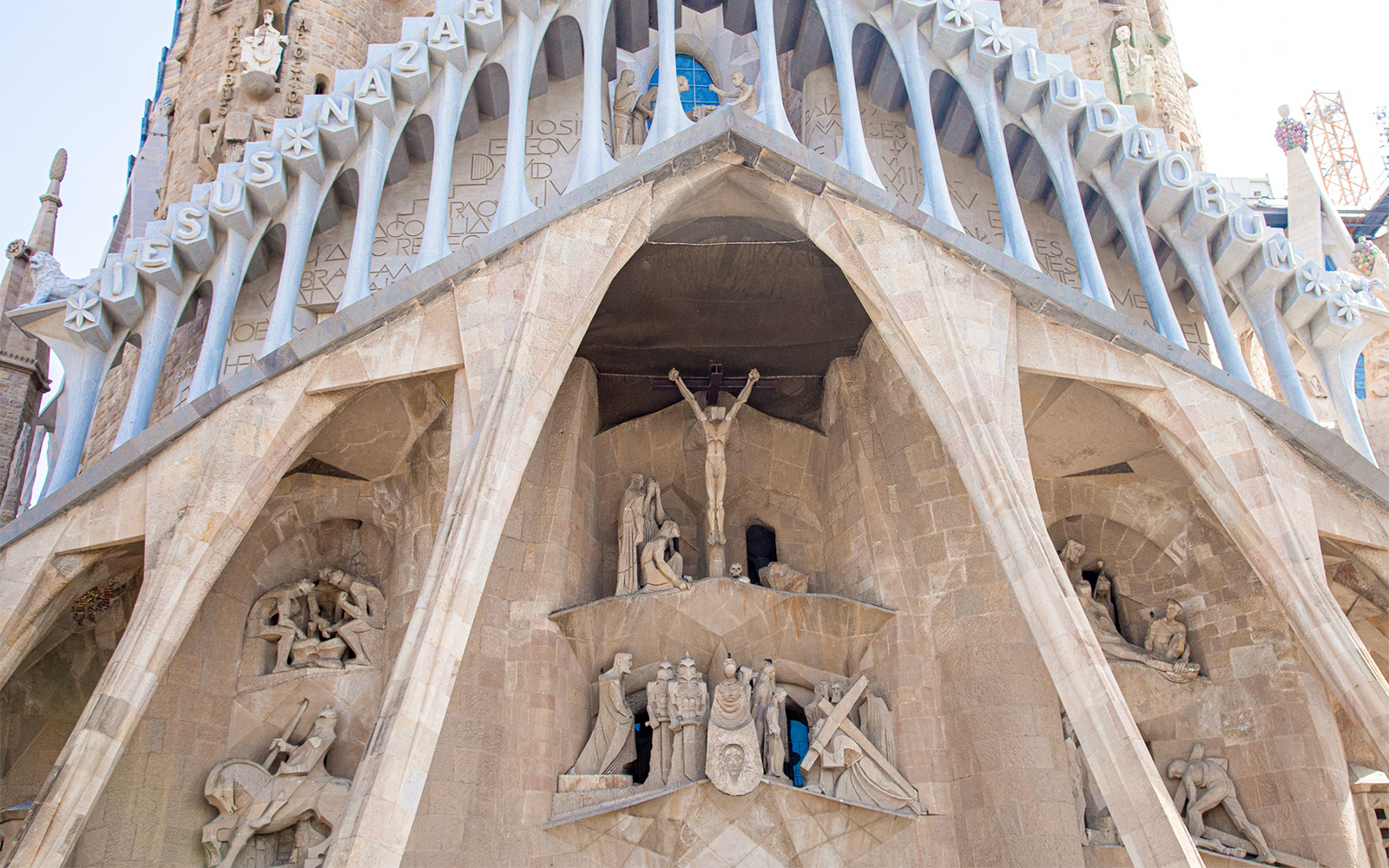
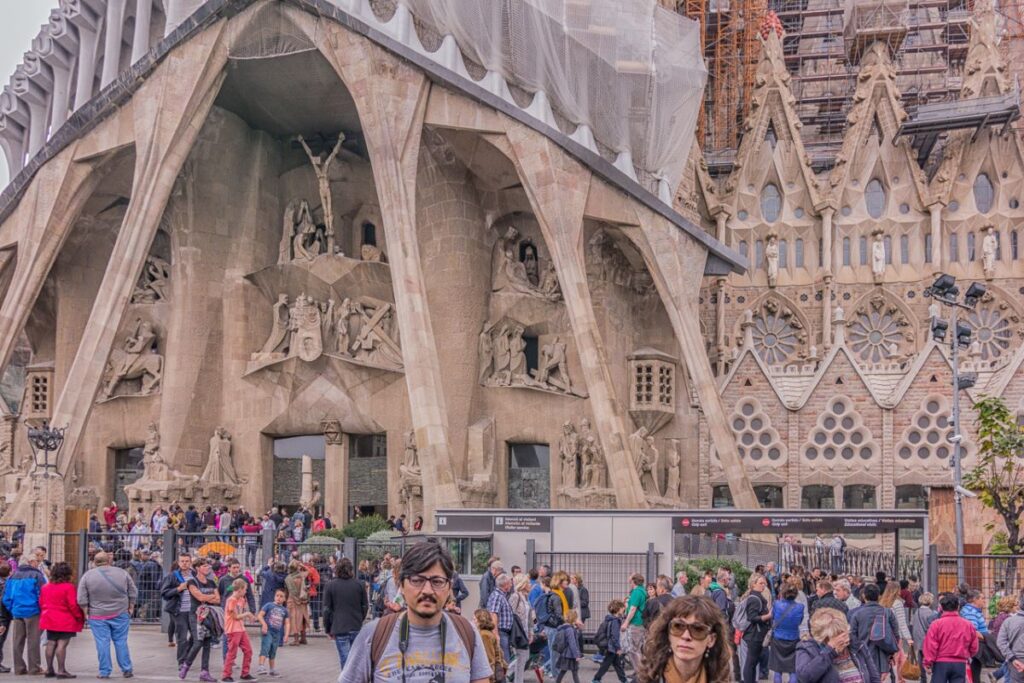
Facing west toward the setting sun, this façade strips away ornament to reveal raw, angular forms that seem carved from bone rather than stone. Where the Nativity Façade overflows with flora, fauna, and joyful detail, the Passion Façade stands bare, austere, and confrontational. It doesn’t invite you to admire—it demands that you sentir.
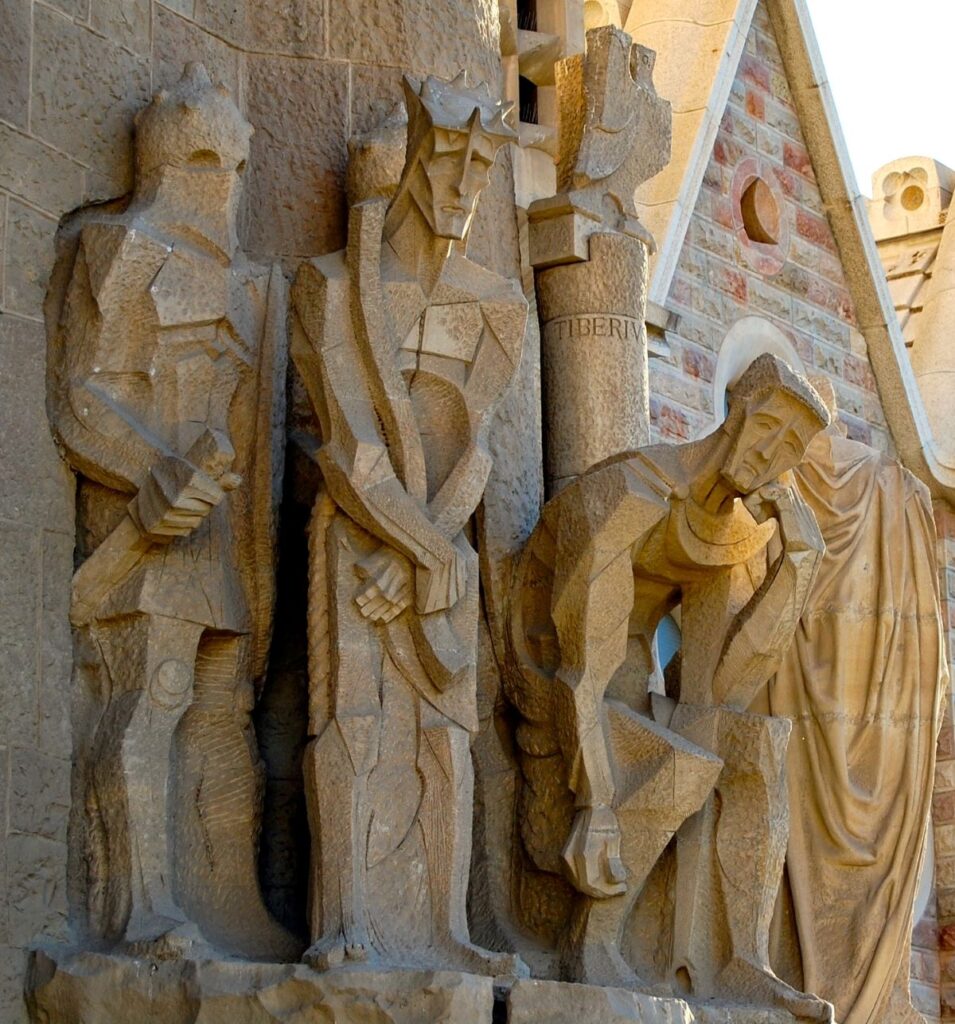
Antoni Gaudí designed this façade to depict the Passion and death of Jesus Christ, but he knew he would not live to see it built. He left sketches, notes, and a clear vision: the architecture itself should express suffering through its very form. The task of realizing this vision fell to sculptor Josep Maria Subirachs, whose stark, expressionist style brought Gaudí’s concept to life in a way that sparked both admiration and controversy.
For tourists visiting the Sagrada Família, understanding the Passion Façade is essential to grasping the basilica’s complete theological narrative. When you know what to look for—the Magic Square adding to 33, the stark figures of the Last Supper, the skeletal columns representing death—you don’t just see stone. You witness a visual sermon on sacrifice, love, and hope born from suffering.
Esta guía completa revela:
- 📜 La historia: From Gaudí’s sketches to Subirachs’ sculptures
- 🎨 El simbolismo: Every angular form and biblical scene decoded
- 🔍 Detalles ocultos: The Magic Square, secret inscriptions, and overlooked elements
- 📸 Los mejores lugares para tomar fotografías: Light, angles, and timing for dramatic shots
- 🗺️ Dónde colocarse: Optimal viewing locations and perspectives
- ⏰ Cuándo visitar: Perfect light conditions for the west-facing façade
- 🎯 Elementos imprescindibles: Tu lista de verificación para la experiencia completa
Whether you’re drawn to religious art, architectural innovation, powerful sculpture, or simply the story behind one of the world’s most extraordinary buildings—this guide unlocks the Passion Façade’s profound message so you can experience it with the depth it deserves.
Chapter 1: Historical Context – From Gaudí’s Vision to Subirachs’ Sculpture
📅 Gaudí’s Original Concept (1917-1926)
While the Nativity Façade was substantially complete during Gaudí’s lifetime, the Passion Façade existed primarily in his imagination, sketches, and a few plaster models.
Gaudí’s Design Philosophy for the Passion Façade:
Unlike the ornate, nature-filled Nativity Façade, Gaudí envisioned the Passion Façade as:
- Stark and angular: Forms should feel stripped bare, like bones
- Ornamentación mínima: No floral details; pure structural expression
- Dramatic shadows: Deep recesses to emphasize suffering
- Narrative clarity: Biblical scenes should be immediately legible
- Impacto emocional: The architecture itself should evoke the weight of Christ’s sacrifice
Why This Contrast? Gaudí explained his reasoning clearly:
“The Nativity Façade is life, joy, abundance. The Passion Façade must be death, sacrifice, austerity. One without the other is incomplete. Faith embraces both.”
This theological duality—birth and death, joy and suffering—is central to Christian understanding, and Gaudí made it architectural.
🏗️ Construction Timeline: 1954-2009
1954: Construction Begins After decades of delay due to the Spanish Civil War (which destroyed many of Gaudí’s models and plans), work finally began on the Passion Façade structure under architect Francesc Quintana, who had worked with Gaudí.
Key Decisions:
- Follow Gaudí’s structural concepts but adapt decorative elements
- Use reinforced concrete for efficiency, then clad in stone
- Prioritize the narrative sequence of Christ’s Passion
1976: Structural Completion The basic framework of the Passion Façade—its columns, arches, and overall form—was completed. The stark, skeletal structure was now visible, but the façade lacked its sculptural soul.
1986: Subirachs Enters the Project Catalan sculptor Josep Maria Subirachs i Sitjar was commissioned to create the sculptural program. This decision would prove both brilliant and controversial.
Who Was Josep Maria Subirachs?
- Born 1927 in Barcelona; died 2014
- Trained in classical sculpture but developed a modernist, expressionist style
- Known for angular, abstracted human forms
- Deeply familiar with Catalan culture and Catholic symbolism
- Shared Gaudí’s commitment to artistic integrity over commercial appeal
Subirachs’ Approach: Rather than imitate Gaudí’s organic naturalism, Subirachs chose a style that complemented the façade’s architectural intent:
- Angular, geometric forms: Echoing the façade’s skeletal structure
- Expressionist abstraction: Figures that convey emotion through form rather than realism
- Minimal detail: Letting negative space and shadow do the work
- Modern materials: Combining traditional stone with bronze and other media
1987-2009: Sculptural Installation Over 22 years, Subirachs and his team created and installed the façade’s sculptural program:
| Año | Major Installation |
|---|---|
| 1987 | Portal sculptures begin |
| 1990 | Last Supper frieze |
| 1995 | Kiss of Judas and Arrest of Jesus |
| 2000 | Crucifixion group |
| 2005 | Resurrection and Ascension elements |
| 2009 | Final details and inscriptions completed |
Controversy and Reception: Subirachs’ style divided opinion:
- Supporters praised the powerful emotional impact and faithful interpretation of Gaudí’s vision of austerity
- Critics argued the modernist style clashed with Gaudí’s organic aesthetic and lacked the warmth of the Nativity Façade
Gaudí’s assistants, who had worked with the master, largely endorsed Subirachs’ approach, recognizing that imitation would have betrayed Gaudí’s intent for contrast.
2009: Completion With the installation of the final sculptural elements, the Passion Façade was declared complete—83 years after Gaudí’s death, but faithful to his vision of stark, suffering beauty.
🎯 Why the Passion Façade Second?
Gaudí’s sequencing of the façades was deeply intentional:
- Nativity first: Begin with hope, life, and joy to inspire continued work
- Passion second: Confront the reality of suffering and sacrifice
- Glory last: Culminate in resurrection and eternal life
This order mirrors the Christian narrative and the spiritual journey: we begin with the wonder of incarnation, confront the cost of redemption, and arrive at the promise of glory.
Chapter 2: Architectural Design – Skeletons of Stone
💀 Gaudí’s Structural Vision
The Passion Façade’s architecture is as much a part of its message as its sculptures. Gaudí designed it to feel stripped bare, like a body after death.
Principios clave de diseño:
1. Angular Geometry Over Organic Curves
Where the Nativity Façade celebrates curves, the Passion Façade embraces angles:
- Columns that taper sharply like bones
- Arches that feel fractured rather than flowing
- Surfaces that seem carved by force rather than grown by nature
Symbolic Meaning: Angles evoke pain, tension, and the harsh reality of suffering.
2. Hyperboloid Structures with a Darker Tone
Gaudí still employed his signature hyperboloid and paraboloid forms, but with a different emotional effect:
- Ventanas hiperboloides: Create dramatic light/shadow contrasts
- arcos parabólicos: Feel like ribs of a skeleton
- Helicoid elements: Suggest spiraling descent rather than upward growth
3. Minimal Ornament, Maximum Impact
Unlike the Nativity Façade’s abundant decoration, the Passion Façade is deliberately sparse:
- Bare stone surfaces
- Deep recesses that create dramatic shadows
- Sculptural elements that stand isolated, emphasizing their emotional weight
Effect: The emptiness itself becomes expressive—like silence in music, or negative space in art.
🏛️ Structural Innovation with Emotional Purpose
The Inclined, Skeletal Columns The Passion Façade’s columns lean at sharp angles, but unlike the Nativity Façade’s tree-like supports, these feel precarious:
- They suggest burden and strain
- Their sharp angles create visual tension
- They appear to bear weight painfully, not gracefully
Symbolic Meaning: Christ bearing the cross; humanity bearing the weight of sin.
The Portal Structure The three portals of the Passion Façade are simpler than those of the Nativity:
- Central Portal: The largest, depicting the Crucifixion
- Left Portal: Scenes of the Last Supper and Betrayal
- Right Portal: Resurrection and Ascension themes
Each portal is framed by stark, angular arches that feel like gates of judgment rather than welcoming entrances.
Light as a Theological Tool Gaudí understood that the west-facing orientation would affect the façade’s appearance:
- Afternoon light rakes across the angular surfaces, emphasizing every plane and shadow
- Sunset casts long, dramatic shadows that enhance the sense of suffering
- Evening illumination (artificial lighting) creates a stark, almost ghostly effect
Material Choices
- Stone: Same Montjuïc sandstone as the Nativity Façade, but left more raw and unpolished
- Bronze: Used for select sculptural elements (e.g., the Kiss of Judas) for contrast
- Concrete: Structural core, then clad in stone—efficient but hidden
Paleta de colores The stone’s natural beige-gold is the same as the Nativity Façade, but the lack of ornament and the play of shadow make it feel colder, more austere.
Chapter 3: Symbolism Decoded – Reading the Narrative of Suffering
The Passion Façade tells the story of Christ’s final days—from the Last Supper to the Crucifixion to the Resurrection. Every sculptural group, every inscription, every angular form contributes to this narrative.
🚪 The Three Portals: Betrayal, Sacrifice, and Hope
Central Portal: The Crucifixion
The Dominant Scene
Positioned at the center as the theological heart of the façade, this portal depicts the Crucifixion of Jesus—the moment of ultimate sacrifice.
Elementos clave:
The Crucified Christ:
- Subirachs’ Christ is emaciated, angular, almost abstract
- Not a realistic depiction but an expression of suffering
- Arms outstretched in the traditional cruciform pose
- Face turned upward in surrender, not agony
Symbolic Meaning:
- Christ’s humanity and divinity united in sacrifice
- The weight of sin borne by one
- Love expressed through self-giving
The Three Marys:
- Mary (mother of Jesus), Mary Magdalene, and Mary of Clopas
- Positioned at the foot of the cross
- Subirachs renders them as angular, grief-stricken figures
- Their postures express sorrow without melodrama
The Centurion:
- Roman soldier who declared, “Truly this was the Son of God” (Matthew 27:54)
- Represents the moment of recognition and faith
- Subirachs depicts him in profile, looking upward
**The Skull and Bones **(Golgotha)
- At the base of the cross
- Traditional symbol of Calvary (“place of the skull”)
- Reminder of mortality and the cost of redemption
Inscripciones:
- “INRI” (Iesus Nazarenus, Rex Iudaeorum – Jesus of Nazareth, King of the Jews)
- Latin phrases from the Passion narratives
- Catalan text emphasizing local connection
Left Portal: The Last Supper and Betrayal
Scenes of Human Frailty
This portal depicts the events leading to Christ’s arrest: the Last Supper, the Agony in the Garden, and the Kiss of Judas.
Elementos clave:
The Last Supper Frieze:
- Long horizontal sculpture above the portal
- Jesus and the twelve apostles at table
- Subirachs’ figures are angular, almost geometric
- Judas is subtly distinguished (turned away, holding a bag of silver)
Symbolic Details:
- Bread and wine simplified to essential forms (Eucharist)
- Apostles’ postures suggest confusion, denial, fear
- Jesus remains calm, centered—foreshadowing his acceptance
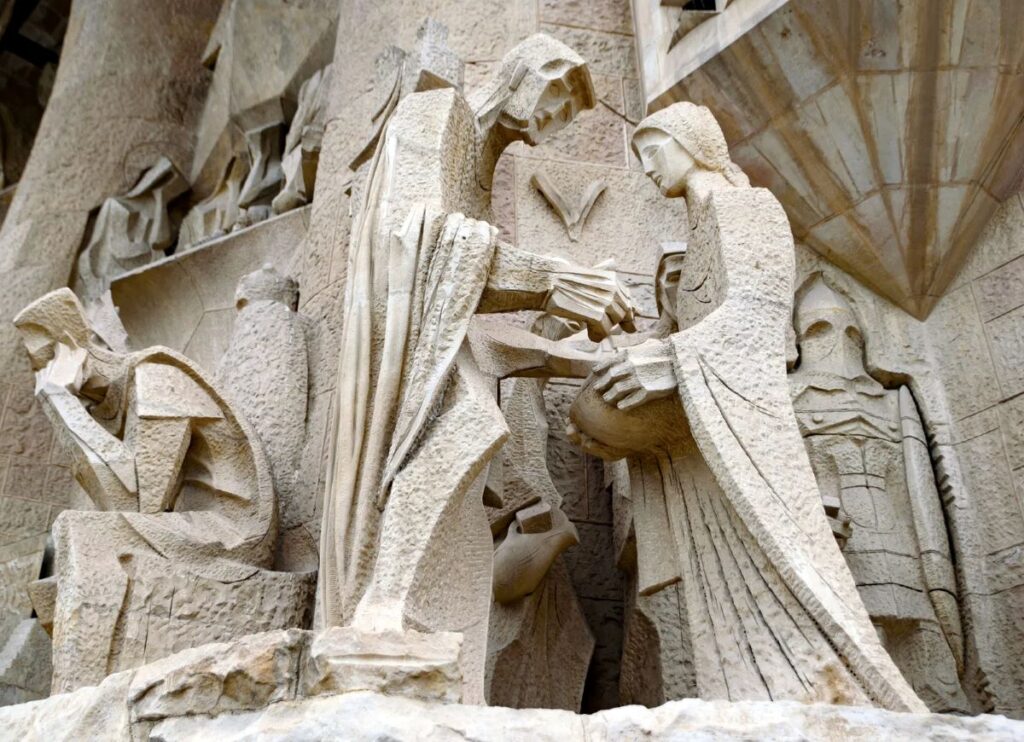
The Agony in the Garden:
- Jesus praying while disciples sleep
- Angel offering the cup of suffering
- Olive trees rendered as stark, twisted forms
The Kiss of Judas:
- One of Subirachs’ most powerful sculptures
- Judas embracing Jesus; the kiss that betrays
- Bronze material contrasts with stone, emphasizing the moment
- Jesus’ face is serene; Judas’ is shadowed, ambiguous
Symbolic Meaning:
- Betrayal by a friend
- The complexity of human choice
- Love that accepts even betrayal
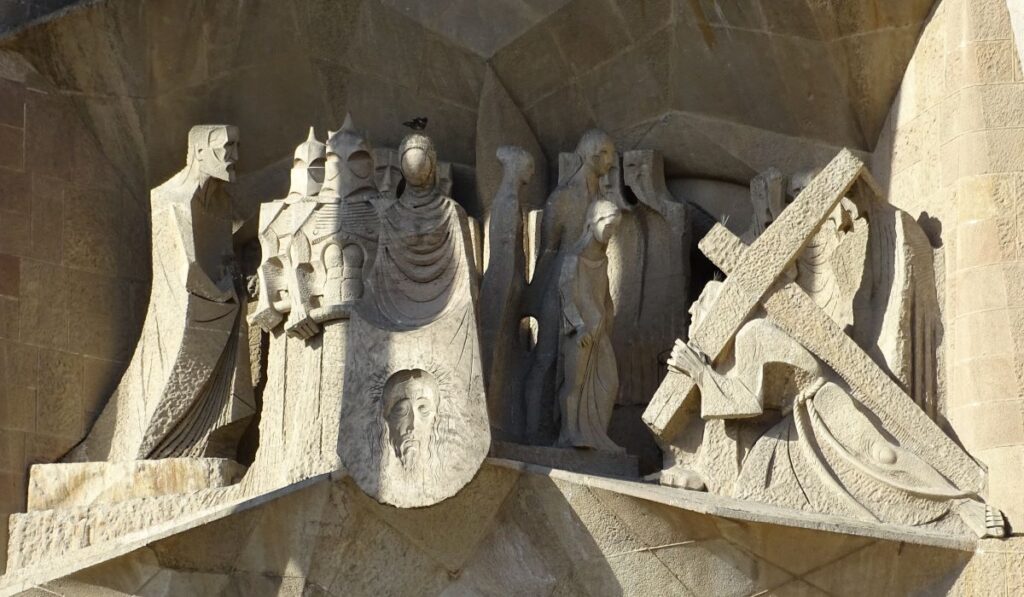
The Arrest of Jesus:
- Soldiers with lanterns and weapons
- Peter cutting off the ear of the high priest’s servant
- Chaos rendered in angular, dynamic forms
Right Portal: Resurrection and Ascension
Hope Beyond Suffering
While the Passion Façade focuses on suffering, it does not end in despair. This portal points toward resurrection and hope.
Elementos clave:
The Empty Tomb:
- Stone rolled away
- Angels announcing, “He is not here; he has risen”
- Light breaking through darkness
The Resurrection Appearance:
- Jesus appearing to Mary Magdalene (“Noli me tangere” – Do not hold on to me)
- Subirachs renders the moment with restraint and dignity
- Mary’s gesture of recognition and awe
The Ascension:
- Jesus ascending to heaven
- Disciples looking upward
- Clouds and light suggesting divine glory
Symbolic Meaning:
- Suffering is not the end
- Death is overcome by life
- Hope is born from sacrifice
🔢 The Magic Square: A Hidden Numerological Puzzle
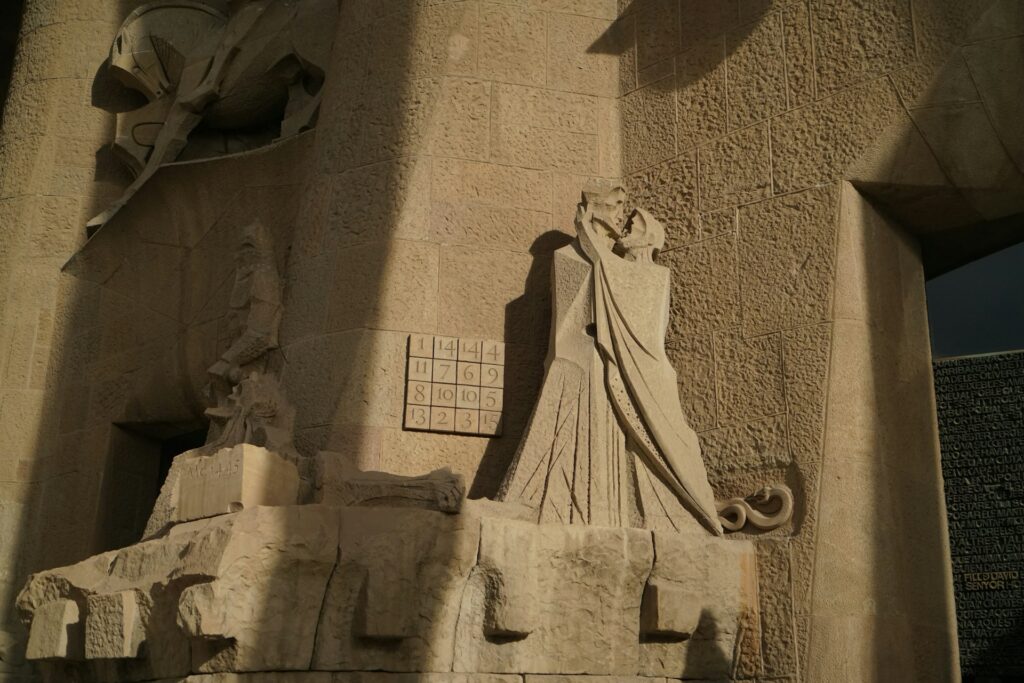
Ubicación: On the Glory Portal (part of the Passion Façade complex), near the Kiss of Judas sculpture
What It Is: A 4×4 grid of numbers carved in stone:
1  14  14  4
11  7   6   9
8  10  10  5
13  2   3  15
The Puzzle: Add the numbers in any row, column, diagonal, or even certain groupings—and they always equal 33.
Why 33?
- The traditional age of Christ at his crucifixion
- A number of spiritual significance in Christian mysticism
- Also the number of degrees in Freemasonry (a subtle nod to Gaudí’s possible connections)
Additional Patterns:
- The two central numbers (10 and 10) add to 20; the two middle numbers of the middle row (7 and 6) add to 13; 20 + 13 = 33
- The four corner numbers (1, 4, 13, 15) add to 33
- Even the numbers in the four quadrants add to 33
Symbolic Meaning:
- Divine order underlying apparent chaos
- The perfection of Christ’s sacrifice
- A hidden message for those who look closely
Consejo para turistas: Many visitors miss the Magic Square because it’s small and positioned high on the portal. Bring binoculars or zoom in with your camera.
✝️ Additional Symbolic Elements
**The Pelican **(Revisited) While the pelican appears prominently on the Nativity Façade as a symbol of charity, it also appears subtly on the Passion Façade—now emphasizing sacrifice rather than nurturing.
The Crown of Thorns:
- Depicted in sculptural details
- Symbol of Christ’s suffering and mockery
- Thorns rendered as sharp, angular forms
The Nails and Spear:
- Instruments of the Passion
- Rendered with stark simplicity
- Reminders of the physical reality of crucifixion
The Veil of Veronica:
- The cloth said to bear Christ’s face
- Symbol of compassion and witness
- Subirachs depicts it as a simple, powerful image
The Rooster:
- Symbol of Peter’s denial (“Before the rooster crows…”)
- Reminder of human weakness and forgiveness
- Positioned subtly near the Last Supper scenes
Olive Trees:
- Gethsemane, where Jesus prayed
- Symbol of peace, but also of suffering (olives must be crushed to produce oil)
- Rendered as twisted, angular forms
🔤 Inscriptions and Text
Languages:
- latín: Traditional language of the Church
- catalán: Gaudí’s and Subirachs’ native language
- Greek: Occasionally, for theological terms
Key Phrases to Find:
latín:
- “Ecce Homo” (Behold the Man – Pilate presenting Christ)
- “Tenebrae factae sunt” (Darkness came over the land)
- “Consummatum est” (It is finished – Christ’s last words)
catalán:
- “Passió” (Passion)
- “Resurrecció” (Resurrection)
- “Esperança” (Hope)
Numerical Inscriptions:
- References to 33 throughout
- Biblical chapter/verse citations
Rosario:
- Carved stone rosary appears subtly
- Connects the Passion to Marian devotion
- Reminder of prayer in suffering
Chapter 4: Subirachs’ Sculptural Style – Modernism Meets Sacred Narrative
🎨 Understanding Subirachs’ Artistic Choices
Josep Maria Subirachs did not imitate Gaudí’s organic naturalism. Instead, he developed a style that complemented the Passion Façade’s architectural intent.
Key Characteristics of Subirachs’ Sculpture:
1. Angular, Geometric Forms
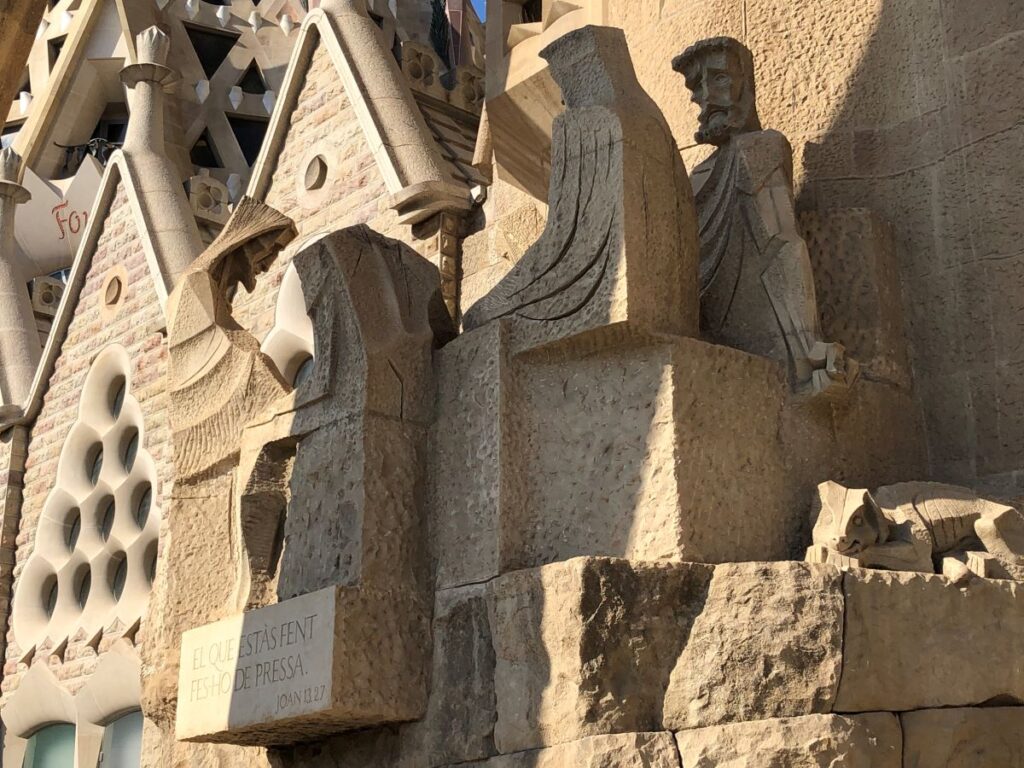
- Figures are abstracted into planes and angles
- Human forms feel carved by force, not grown by nature
- Creates visual tension that echoes emotional tension
Why This Works:
- Matches the façade’s skeletal architecture
- Emphasizes the harshness of the Passion narrative
- Avoids sentimental realism; focuses on emotional truth
2. Expressionist Abstraction
- Faces are simplified; emotion is conveyed through posture and form
- Details are omitted to focus on essential meaning
- Negative space is as important as solid form
Effect:
- Viewers project their own emotions onto the ambiguous forms
- The sculptures feel timeless, not tied to a specific historical style
- The abstraction invites contemplation rather than mere observation
3. Minimal Detail, Maximum Impact
- Subirachs uses restraint: a few carefully placed details convey volumes
- Hands, faces, and gestures are simplified but powerful
- Ornament is avoided; the form itself carries meaning
Philosophy:
“Less is more when the subject is suffering. Decoration distracts from the message.” — Subirachs (paraphrased)
4. Material Contrast
- Primarily stone, but bronze used for key moments (e.g., Kiss of Judas)
- Different textures create visual interest without ornament
- Bronze figures stand out against stone, emphasizing their narrative importance
🗣️ The Controversy: Did Subirachs Betray Gaudí?
When Subirachs’ work was first revealed, it sparked debate:
Critics Argued:
- The modernist style clashed with Gaudí’s organic aesthetic
- The abstraction lacked the warmth and detail of Gaudí’s work
- The façade felt cold compared to the Nativity’s abundance
Supporters Responded:
- Subirachs faithfully interpreted Gaudí’s vision of austerity
- Imitation would have been dishonest; contrast was the point
- The emotional power of the sculptures honors Gaudí’s intent
The Verdict of Time: Today, most scholars and visitors recognize that Subirachs’ work, while different in style, is faithful to Gaudí’s theological and artistic vision. The contrast between the two façades is not a flaw—it is the point.
**Gaudí’s Own Words **(Paraphrased)
“Do not copy me. Understand what I was trying to say, and say it in your own voice.”
Subirachs did exactly that.
🔍 Subirachs’ Hidden Signatures
Like many artists, Subirachs included subtle personal touches:
His Initials:
- “S” and “JMS” appear in small carvings
- A humble signature, not ostentatious
The Date 1987:
- When he began work on the project
- Carved subtly into a corner
Catalan Symbols:
- References to Catalan culture and identity
- A nod to Gaudí’s own Catalan pride
Consejo para turistas: Look closely at the base of sculptures and in corners—you might spot these hidden details.
Capítulo 5: Detalles ocultos: lo que la mayoría de los turistas se pierden.
The Passion Façade rewards careful observation. While most visitors photograph the grand Crucifixion scene, the los detalles más pequeños A menudo encierran un significado profundo. Aquí tienes tu guía para la búsqueda del tesoro:
🔢 The Magic Square (Revisited)
Ubicación: Glory Portal, high on the façade near the Kiss of Judas
What to Do:
- Bring binoculars or zoom with your camera
- Count the rows, columns, diagonals—they all add to 33
- Notice the two central 10s; the symmetry is intentional
Por qué es importante: A hidden mathematical perfection underlying the narrative of suffering—divine order in apparent chaos.
🗝️ The Key of Saint Peter
Ubicación: Near the Last Supper scenes
Simbolismo:
- Peter was given the “keys to the kingdom” (Matthew 16:19)
- Despite his denial, he is forgiven and entrusted with leadership
- Symbol of mercy and restoration
Detalle: The key is subtly carved, easy to miss among the larger figures.
🕊️ The Dove of Peace
Ubicación: Near the Resurrection scenes
Simbolismo:
- Espíritu Santo
- Peace after suffering
- Hope rising from despair
Detalle: The dove is small and stylized; look for it in the upper sections.
🌑 The Shadow Play
Not a Sculpture, but Essential: The Passion Façade is designed for afternoon light, when the sun rakes across its angular surfaces.
What to Notice:
- How shadows deepen the emotional impact
- How certain details emerge only at specific times
- How the façade changes throughout the day
Consejo profesional: Visit between 3:00-5:30 PM for the most dramatic light.
✍️ Subirachs’ Signature Gesture
Ubicación: On the arm of one of the Marys at the Crucifixion
Detalle: A small, stylized hand gesture that appears in other Subirachs works—a personal artistic signature.
Por qué es importante: A reminder that this is the work of a specific artist, interpreting Gaudí’s vision through his own voice.
📜 The Small Inscriptions
Ubicación: Scattered throughout the façade
Textos para encontrar:
- Biblical verse references (e.g., “Mt 27:45” for the darkness at crucifixion)
- Catalan words for “suffering,” “hope,” “love”
- Numerical references to 33
Tip: Bring a small notebook to jot down inscriptions you want to research later.
🪨 The Texture Variations
Observation Exercise: Run your eyes (not your hands—please don’t touch!) over the stone surfaces.
What to Notice:
- Some areas are smooth; others are rough
- Tool marks are visible in places
- The variation is intentional: different textures convey different emotions
Symbolic Meaning:
- Smooth = peace, resolution
- Rough = struggle, pain
- The façade itself is a text to be “read” through touch (visually)
🔥 The Flame Motif
Ubicación: Near the Resurrection scenes
Simbolismo:
- The Holy Spirit as fire (Acts 2:3)
- Purification through suffering
- Light emerging from darkness
Detalle: Stylized flames carved in low relief; easy to overlook.
🧭 The Directional Symbolism
East vs. West:
- Nativity Façade (east): sunrise, birth, beginning
- Passion Façade (west): sunset, death, ending (but also promise of new dawn)
What to Notice:
- How the west-facing orientation affects light and shadow
- How the façade feels different in morning vs. afternoon light
- The theological significance of direction in Christian architecture
Chapter 6: Photography Guide – Capturing the Drama of Suffering
🌅 Best Times for Photography
The Passion Façade faces west, lo cual afecta drásticamente tus opciones fotográficas:
🌞 Afternoon Light (3:00 PM – 6:00 PM) ⭐ MEJOR
Ventajas:
- Direct sunlight rakes across the angular surfaces
- Deep shadows emphasize sculptural relief and emotional tension
- Warm, golden tones enhance the stone’s color
- Dramatic contrast perfect for black-and-white conversion
- Fewer crowds in late afternoon
Lo mejor para:
- Overall façade shots with dramatic shadows
- Detail photography emphasizing texture and form
- Silhouettes against the glowing stone
- Black-and-white conversions (the façade is naturally high-contrast)
Ajustes:
- Aperture: f/8-f/11 for sharpness across the façade
- ISO: 200-400 (afternoon light is bright)
- Shutter: 1/250s or faster to freeze detail
- Balance de blancos: Luz diurna o nublado (aumenta la calidez)
- Consider exposure compensation: -0.3 to -1.0 EV to protect highlights
🌆 Golden Hour (1 hour before sunset)
Tiempo mágico:
- Low-angle light creates long, dramatic shadows
- Warm tones intensify the stone’s color
- The façade feels almost alive with light and shadow
- Perfect for emotional, atmospheric shots
Ajustes:
- Aperture: f/5.6-f/8
- ISO: 400-800 (light is fading)
- Shutter: 1/125s or faster (use image stabilization)
- White balance: Cloudy or shade (enhances warmth)
- Bracket exposures for HDR if desired
🌃 Blue Hour (After Sunset)
Dramatic Alternative:
- Fachada iluminada por luces artificiales
- Deep blue sky creates striking contrast
- Fewer tourists; more contemplative atmosphere
- Artificial lighting emphasizes different details than sunlight
Ajustes:
- Trípode imprescindible
- Apertura: f/8-f/11
- ISO: 800-1600
- Tiempo de obturación: 1-4 segundos
- Balance de blancos: Tungsteno o luz diurna (experimento)
- Long exposure can blur moving clouds for added drama
🌤️ Morning Light (Avoid for This Façade)
Why It’s Challenging:
- Façade is in shadow
- Flat, even light reduces dramatic impact
- Shadows that emphasize form are absent
If You Must Shoot in Morning:
- Focus on details rather than overall composition
- Use black-and-white to emphasize form over light
- Look for reflected light from surrounding buildings
📐 Mejores ángulos y composiciones
Angle 1: Straight-On from Carrer de Sardenya
Ubicación: Street directly in front of the façade
Lo que obtienes:
- Fachada completa enmarcada
- Symmetrical composition emphasizing the central Crucifixion
- Context of surrounding Eixample architecture
- Classic documentary shot
Consejos:
- Utilice un objetivo gran angular (16-35 mm).
- Arrive in afternoon for best light
- Include street elements for urban context
- Consider vertical orientation to emphasize height
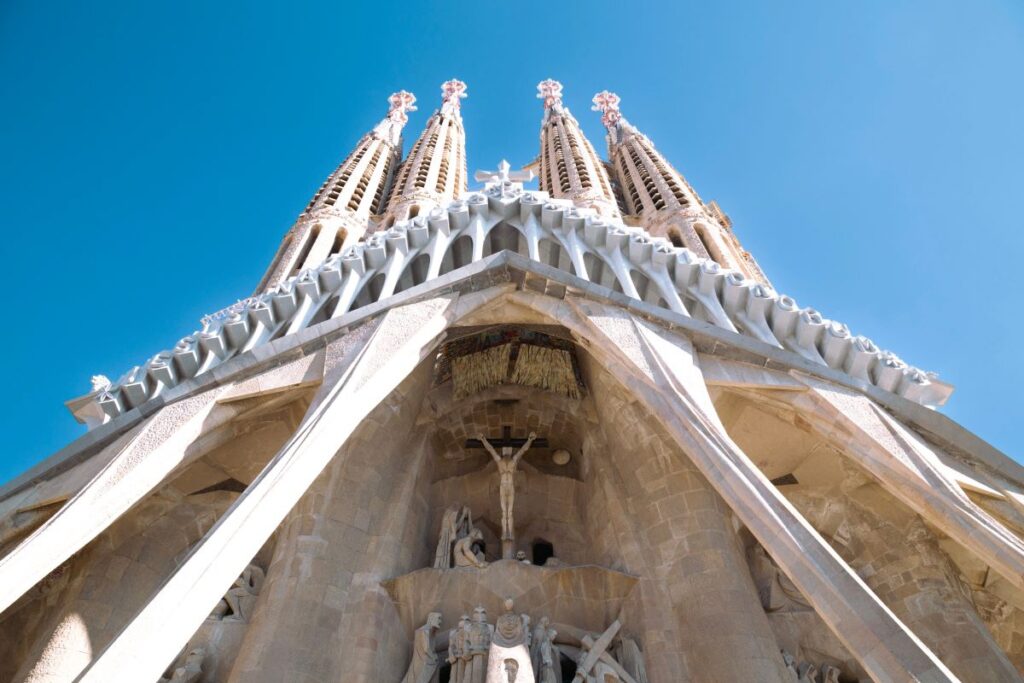
Ángulo 2: Ángulo bajo desde la base
Ubicación: De pie al pie de la fachada
Lo que obtienes:
- Perspectiva ascendente espectacular
- Emphasizes the skeletal, imposing nature of the architecture
- Towers appear to pierce the sky
- Sense of awe and intimidation (intentional)
Consejos:
- Objetivo ultra gran angular (14-24 mm)
- Include people for scale (emphasizes monumentality)
- Watch for distortion; correct in post if needed
- Best in afternoon light for shadow drama
Ángulo 3: Primeros planos de detalle
Ubicación: Move along the façade, focusing on specific sculptural groups
Lo que obtienes:
- Subirachs’ expressive figures
- Textural studies of stone
- Symbolic elements (Magic Square, inscriptions, etc.)
- Unique, intimate perspectives
Consejos:
- Teleobjetivo (70-200 mm) o macro
- Shallow depth of field (f/2.8-f/4) for subject isolation
- Focus on eyes or hands of figures for emotional impact
- Look for patterns: repetition of angles, play of light and shadow
Ángulo 4: Oblicuo desde el lateral
Ubicación: Corner of Carrer de Sardenya and Carrer de Provença
Lo que obtienes:
- Three-dimensional perspective showing depth
- Side view of portals reveals sculptural layering
- Torres de perfil
- Less common, more artistic angle
Consejos:
- Objetivo estándar (35-50 mm)
- Afternoon light creates dramatic side shadows
- Include architectural context of surrounding buildings
- Good for storytelling compositions
Ángulo 5: Desde el acceso a la torre
Ubicación: Inside the Passion towers (requires tower ticket)
Lo que obtienes:
- Vista aérea de los detalles de la fachada
- Unique downward perspective on sculptural groups
- Close-up of angular architectural elements
- Sensación de estar entre bastidores
Consejos:
- Gran angular para dar contexto
- Careful with narrow spaces; no tripods allowed
- Respect other visitors; be quick and unobtrusive
- Focus on details impossible to see from ground level
🎨 Composition Techniques for the Passion Façade
Regla de los tercios:
- Place the Crucifixion group on a third line
- Position the Magic Square at an intersection point
- Crea una composición dinámica y equilibrada.
Líneas principales:
- Use the sharp angles of columns to guide the eye
- Follow the lines of arches toward the central scene
- Creates visual tension that mirrors emotional tension
Enmarcado:
- Use angular arches to frame sculptural groups
- Crea límites naturales con elementos arquitectónicos.
- Adds depth and focuses attention
Symmetry and Asymmetry:
- The façade is roughly symmetrical, but Subirachs’ sculptures introduce intentional asymmetry
- Play with both: center for formal impact; off-center for dynamic tension
Contrast:
- Light vs. shadow is the façade’s native language
- Emphasize contrast in post-processing
- Black-and-white conversion often enhances the dramatic impact
Negative Space:
- The Passion Façade uses emptiness expressively
- Don’t feel compelled to fill the frame
- Let bare stone and shadow carry meaning
📱 Consejos para fotografiar con el smartphone
Consejos para iPhone:
- Usar Modo retrato Para tomas de detalle (crea un agradable desenfoque de fondo).
- Permitir HDR inteligente for high-contrast scenes (common on this façade)
- Tap to focus on sculptural details, then slide to adjust exposure
- Usar Modo nocturno Para fotos durante la hora azul (mantenga la cámara firme o use un mini trípode).
- Entrar como un torbellino ProRAW if available for maximum editing flexibility
Consejos para Android:
- Usar Modo Pro for manual control of exposure and focus
- Permitir HDR+ para una exposición equilibrada en escenas de alto contraste
- Toca para enfocar y ajustar la exposición; bloquea el enfoque automático/exposición automática para mayor consistencia.
- Usar Visión nocturna para fotografía con poca luz durante la hora azul
- Entrar como un torbellino CRUDO si está disponible para mayor flexibilidad en el posprocesamiento
Consejos universales:
- Clean your lens before shooting (dust and fingerprints reduce sharpness)
- Utilice las líneas de la cuadrícula para la composición (actívela en la configuración de la cámara).
- Mantén pulsado para bloquear el enfoque/exposición y obtener fotos consistentes.
- Utilice los botones de volumen como disparador (reduce la vibración de la cámara).
- Edita en Lightroom Mobile o Snapseed para obtener resultados profesionales.
Black-and-White Conversion: The Passion Façade is naturally suited to monochrome:
- High contrast between light and shadow
- Angular forms read powerfully without color
- Emotional impact is enhanced by the timeless quality of B&W
Mobile Workflow:
- Shoot in color (gives more editing options)
- Convert to B&W in post (Lightroom Mobile, Snapseed, VSCO)
- Adjust contrast and clarity to emphasize form
- Consider a slight vignette to focus attention on central elements
Chapter 7: Visiting the Passion Façade – Practical Information
📍 Ubicación y acceso
DIRECCIÓN:
Carrer de Sardenya, s/n
08013 Barcelona, España
Mejor ubicación para observar:
Carrer de Sardenya – the street directly in front of the façade, or the small plaza at the intersection with Carrer de Provença
Cómo llegar allí:
En metro:
- **L2** (Morado) o **L5** (Azul) hasta la estación Sagrada Família
- Exit toward Carrer de Sardenya
- A 2 minutos a pie de la fachada.
En autobús:
- Rutas: 19, 33, 34, 43, 44, 50, 51, H10
- Stop: “Sagrada Família” or “Sardenya – Provença”
- 1-2 minute walk
En taxi/servicio de transporte compartido:
- Drop-off at Carrer de Sardenya or Carrer de Provença
- Most direct option; specify “Passion Façade entrance”
Caminando:
- Desde Passeig de Gràcia: 15 minutos
- Desde el Barrio Gótico: 25 minutos
- From Park Güell: 20 minutes (mostly downhill)
⏰ Mejores épocas para visitar
Para fotografía:
- **Afternoon **(3:00-5:30 PM): Best light for dramatic shadows and warm tones
- **Golden hour **(1 hour before sunset): Magical, emotional atmosphere
- **Blue hour **(after sunset): Striking contrast between illuminated façade and dark sky
Para la contemplación:
- Weekday afternoons: Quieter than mornings; fewer tour groups
- Atardecer: Crowds thinning; more space for reflection
- Avoid Sundays during Mass: The façade is near the main entrance; worship takes priority
Para evitar:
- **Mid-morning **(10:00 AM-12:00 PM): Peak crowds; façade in shadow
- Fines de semana: Más concurrido por lugareños y turistas
- Holy Week: Extremely crowded; consider visiting another time for contemplation
🎫 Opciones de visualización
Visitas exteriores gratuitas:
- You can admire the Passion Façade from the street sin entrada
- Perfecto para la fotografía y la apreciación inicial.
- No se permite el acceso al interior ni a las torres.
**Visita al interior** (Requiere entrada)
- See the connection between Passion Façade and interior
- Comprender cómo el simbolismo exterior continúa en el interior
- Access to museum with Gaudí’s models and Subirachs’ sketches
- Se requiere boletoReserva con antelación en sagradafamilia.org
**Acceso a la torre** (Requiere actualización)
- Elevator to Passion towers
- Close-up views of façade details and sculptural elements
- Panoramic Barcelona views from the west side
- Descenso por escalera de caracol
- Tarifa adicionalReserve al comprar las entradas.
- No accesible para sillas de ruedas
♿ Accesibilidad
Visualización exterior:
- Totalmente accesible desde la planta baja.
- Smooth sidewalks on Carrer de Sardenya
- Benches nearby for resting
- Accessible restrooms in surrounding area
Interior:
- Accesible para sillas de ruedas
- Ascensores a todas las plantas (excepto las torres).
- Baños accesibles
- Préstamo de sillas de ruedas disponible (reservar con antelación).
Torres:
- NO accesible – Se requiere una escalera de caracol para el descenso.
- No hay ascensor para bajar
- No se recomienda para personas con problemas de movilidad, claustrofobia o niños pequeños.
🕐 Duración recomendada de la visita
Solo exterior: 20-30 minutos
Exterior + Interior: 1,5-2 horas
**Experiencia completa** (exterior, interior, torres, museo) 2,5-3 horas
📱 Audioguía y recorridos
Guía de audio oficial:
- Incluido con la mayoría de las entradas.
- Disponible en más de 10 idiomas.
- Detailed explanation of Passion Façade symbolism and Subirachs’ work
- Descarga la aplicación antes de tu llegada.
Visitas guiadas:
- Expert commentary on theological and artistic context
- Acceso sin colas
- Deeper exploration of Subirachs’ sculptures and Gaudí’s vision
- Coste adicional (aproximadamente 15-25 €)
- Book in advance; specify interest in Passion Façade
Chapter 8: The Passion Façade in Context – Comparing the Three Façades
La Sagrada Familia tiene tres grandes fachadas, each with distinct character and purpose. Understanding their differences enhances your appreciation of the Passion Façade.
🔄 The Three Façades Compared
| Característica | Fachada del Nacimiento | Fachada de la Pasión | Fachada de la Gloria |
|---|---|---|---|
| Dirección | Este (amanecer) | Oeste (puesta de sol) | Sur (entrada principal) |
| Tema | Nacimiento, vida, alegría | Muerte, sufrimiento, sacrificio | Resurrección, gloria, vida eterna |
| Estilo | Ornamentado, orgánico, naturalista | Áspero, anguloso, esquelético | Grandioso, monumental (en construcción) |
| La participación de Gaudí | Diseñado y casi terminado | Diseñado y construido después de su muerte. | Diseñado, en construcción |
| Fecha de finalización | ~1930 | 1976 (estructura), 2009 (escultura) | Estimado para 2030+ |
| Escultor | El taller de Gaudí | Josep Maria Subirachs | Diversos artistas contemporáneos |
| Ánimo | Celebratorio, esperanzador, abundante | Sombrío, dramático, austero | Triunfante, universal, cósmico |
| Decoración | Densidad máxima | Piedra desnuda minimalista | Será elaborado |
| Simbolismo | Vida, naturaleza, esperanza | Muerte, sacrificio, redención | Gloria, cielo, el camino de la humanidad hacia Dios |
🎭 The Theological Journey
Las tres fachadas crean una narración espiritual:
- **Natividad** (Oriente): Nacimiento y encarnación: Dios se hace humano.
- **La Pasión** (Occidente): Muerte y redención – Sufrimiento humano y sacrificio divino
- **Gloria** (Sur): Resurrección y vida eterna: el destino final de la humanidad.
Recorriendo el senderoAl recorrer la fachada del Nacimiento y luego la de la Pasión, se experimenta la historia completa de Cristo: desde la alegría del nacimiento hasta la agonía de la cruz. La fachada de la Gloria (una vez terminada) completará el recorrido con la promesa de la resurrección.
🎨 Artistic Contrast: Nativity vs. Passion
El contraste es intencional y dramático:
Natividad:
- Curvas, formas orgánicas
- Abundante decoración
- Elementos naturales por todas partes
- Cálido y acogedor
- Celebra la creación
Pasión:
- Líneas rectas, ángulos agudos
- Estructura esquelética desnuda
- Ornamentación mínima
- Crudo, desafiante
- Se enfrenta al sufrimiento
La intención de Gaudí:
“La fachada de la Natividad representa la vida, la alegría y la abundancia. La fachada de la Pasión representa la muerte, el sacrificio y la austeridad. Ambas son necesarias. Una sin la otra está incompleta.”
Este contraste enseña que la fe cristiana abarca tanto la alegría como el sufrimiento, el nacimiento y la muerte, la esperanza y el sacrificio.
Subirachs’ Contribution: By choosing a modernist, expressionist style rather than imitating Gaudí’s organic naturalism, Subirachs honored the spirit of Gaudí’s vision: contrast, not imitation.
Chapter 9: Preservation and Conservation – Protecting a Modern Masterpiece
🏛️ El desafío del tiempo
The Passion Façade is a relatively recent completion (sculpture finished in 2009), but it faces the same conservation challenges as the older Nativity Façade.
Amenazas a la fachada:
- Desgaste:
- Rain erosion on angular surfaces
- Fluctuaciones de temperatura que provocan expansión/contracción
- Cristalización de la sal a partir del aire marino
- Contaminación:
- La lluvia ácida daña la piedra
- Superficies ennegrecidas por partículas
- Reacciones químicas con minerales de piedra
- Crecimiento biológico:
- Lichen and moss in recessed areas
- Raíces de plantas en grietas
- Excrementos de aves (ácidos)
- Impacto humano:
- Contacto y manipulación (aceites de la piel)
- Vibración del turismo
- Fotografía con flash (mínima pero acumulativa)
🔧 Esfuerzos de conservación
Trabajo en curso:
Limpieza de piedra:
- Métodos suaves para eliminar contaminantes
- Laser cleaning for delicate sculptural details
- Cataplasmas químicos para depósitos persistentes
- Never abrasive methods that damage Subirachs’ precise carving
Monitoreo estructural:
- Escaneo láser 3D para detectar movimiento.
- Sensores que miden la tensión y la vibración.
- Inspecciones periódicas realizadas por ingenieros estructurales.
- Reparación inmediata de grietas o inestabilidad.
Restauración de esculturas:
- Expertos talladores de piedra reparan los elementos dañados.
- Utilice la misma arenisca de Montjuïc siempre que sea posible.
- Documentar cada intervención
- Métodos reversibles cuando sea factible
Medidas de protección:
- Limitar el contacto directo
- Controlar el flujo de visitantes
- Instalar barreras de protección donde sea necesario
- Monitoreo climático
🌱 Turismo sostenible
Equilibrar el acceso y la preservación:
The Sagrada Família Foundation faces the challenge of allowing millions to experience Subirachs’ work while protecting it for future generations.
Estrategias:
- Entrada programadaControla la densidad de la multitud
- Senderos designados: Previene el desgaste en zonas sensibles
- EducaciónInformar a los visitantes sobre la conservación.
- FondosLa venta de entradas financia directamente la conservación.
- Investigación: Estudio en curso de materiales y métodos
Su papel como visitante:
✅ Hacer:
- Siga todas las directrices publicadas.
- Manténgase en los senderos señalizados.
- Don’t touch sculptures (oils damage stone)
- Informe de los daños al personal.
- Respeta el espacio
❌ No:
- Escalar cualquier elemento
- Tocar las tallas (los aceites de la piel dañan la piedra)
- Dejar basura o grafitis
- Utilice la fotografía con flash.
- Ignore las instrucciones del personal.
💰 Financiamiento para la conservación
¿A dónde va el dinero de tu boleto?:
La Sagrada Familia recibe Sin financiación gubernamental. Todos los costos de construcción y conservación provienen de:
- Venta de entradas (~80%)
- Donaciones privadas (~15%)
- Mercancías y publicaciones (~5%)
Tu visita financia directamente:
- Ongoing construction of the Glory Façade
- Conservation of completed sections (Nativity and Passion)
- Investigación y documentación
- Programas educativos
- salarios del personal
Esto te convierte en patrocinador.—contributing to the continuation of Gaudí’s and Subirachs’ vision.
Chapter 10: Frequently Asked Questions – Passion Façade
❓ Why does the Passion Façade look so different from the Nativity Façade?
A: The contrast is intentional. Gaudí designed the Nativity Façade to celebrate birth, life, and joy—so it’s ornate and abundant. He designed the Passion Façade to depict suffering and sacrifice—so it’s stark and austere. This theological duality teaches that faith embraces both joy and sorrow.
❓ Who sculpted the Passion Façade figures?
A: Catalan sculptor Josep Maria Subirachs (1927-2014) created the sculptural program between 1987-2009. He chose a modernist, expressionist style that complemented Gaudí’s vision of austerity rather than imitating Gaudí’s organic naturalism.
❓ What is the Magic Square and why does it add to 33?
A: The Magic Square is a 4×4 grid of numbers where every row, column, diagonal, and many other groupings add to 33—the traditional age of Christ at his crucifixion. It’s a hidden numerological puzzle symbolizing divine order underlying the narrative of suffering.
❓ ¿Puedo tocar las esculturas?
A: No. Los aceites y ácidos de la piel humana dañan la piedra con el tiempo. Con millones de visitantes, incluso el roce suave provoca daños acumulativos. Admírela con la vista, no con las manos.
❓ What’s the best time of day to photograph the Passion Façade?
A: **Afternoon **(3:00-5:30 PM) when direct sunlight rakes across the west-facing façade, creating dramatic shadows that emphasize the angular forms. Golden hour (1 hour before sunset) is also spectacular for warm, emotional shots.
❓ ¿Es seguro visitar las torres?
ASí, con precauciones. Las torres son estructuralmente sólidas y se inspeccionan periódicamente. Sin embargo:
- No apto para personas con problemas de movilidad, claustrofobia o afecciones cardíacas.
- Los niños deben estar supervisados.
- Siga todas las instrucciones de seguridad.
- Sujétate a los pasamanos en la escalera de caracol.
- No se permiten trípodes ni bolsas grandes.
❓ Why did Subirachs use such a different style from Gaudí?
A: Subirachs believed that imitating Gaudí’s style would have betrayed Gaudí’s intent. Gaudí wanted the Passion Façade to feel stark and austere; Subirachs’ angular, expressionist style achieves that emotional impact. Contrast, not imitation, was the goal.
❓ Can I visit just the Passion Façade without entering the basilica?
A: Yes! You can admire the exterior from Carrer de Sardenya and surrounding streets gratis Sin entrada. Sin embargo, para comprender todo el simbolismo y ver cómo se relaciona con el interior, se recomienda encarecidamente entrar en la basílica.
❓ ¿En qué idioma están escritas las inscripciones?
A: Principalmente latín (traditional language of the Catholic Church) and catalán (Gaudí’s and Subirachs’ native language). You’ll find phrases like “Ecce Homo” (Latin) and “Passió” (Catalan).
❓ Is the Passion Façade complete?
A: Yes. The structural work was completed in 1976, and Subirachs’ sculptural program was finished in 2009. While minor conservation work continues, the façade as Gaudí envisioned it is complete.
❓ What’s the significance of the west-facing orientation?
A: The west is traditionally associated with sunset, ending, and death in Christian symbolism. By facing the Passion Façade west, Gaudí connected the architecture to the theological theme: Christ’s death as the “sunset” that precedes the “sunrise” of resurrection.
❓ Can I propose or have a wedding at the Passion Façade?
A: Los eventos privados requieren autorización previa. y, por lo general, no están permitidas durante el horario de visitas habitual. La basílica sí celebra bodas, pero deben concertarse con suficiente antelación a través de la Fundación Sagrada Familia. Se toleran las pedidas de mano informales en las zonas comunes, siempre que sean breves y respetuosas.
Chapter 11: Your Passion Façade Visit Checklist
✅ Antes de irte
Investigación y planificación:
- Lee sobre el simbolismo (¡lo estás haciendo ahora!).
- Watch documentaries about Subirachs and the Passion Façade
- Descárgate la app oficial de la Sagrada Familia
- Reserva tus entradas con antelación (especialmente para acceder a la torre).
- Check weather forecast (afternoon sun is ideal)
- Plan arrival time (3:00-4:00 PM recommended)
Qué llevar:
- Zapatos cómodos para caminar
- Cámara o teléfono inteligente (con batería completamente cargada)
- Batería/cargador portátil
- botella de agua
- Sunscreen and hat (for afternoon exterior viewing)
- Bufanda o chal ligero (para visitas al interior; código de vestimenta).
- Libreta pequeña para dibujar o tomar notas.
- Binoculars (optional, for seeing high details like the Magic Square)
Qué dejar atrás:
- Mochilas o equipaje grandes (no hay servicio de consigna en el establecimiento).
- No se permite comer ni beber en el interior.
- Trípodes (no se recomiendan durante las horas punta)
- Palos para selfies (prohibidos en el interior)
- Equipos de fotografía con flash
✅ Día de la visita
Afternoon Preparation:
- Vístase apropiadamente (hombros y rodillas cubiertos para el interior).
- Eat lunch beforehand (no food inside basilica)
- Carga todos los dispositivos durante la noche.
- Captura de pantalla del código QR del ticket como respaldo
- Configurar alarmas en el teléfono para la hora de salida.
- Consulta los horarios del metro y los autobuses en tiempo real.
A la llegada:
- Llegue entre 20 y 25 minutos antes de la hora de entrada.
- Start at Carrer de Sardenya for exterior viewing
- Photograph façade in afternoon light
- Note details you want to see up close (Magic Square, inscriptions)
- Pase por el control de seguridad
- Valide su boleto en los torniquetes.
- Descargar/acceder a la audioguía
- Begin with Passion Façade interior connection
✅ Mientras se observa la fachada
Lista de verificación exterior:
- Overall view from Carrer de Sardenya
- Central Portal: Crucifixion scene
- Left Portal: Last Supper, Kiss of Judas
- Right Portal: Resurrection, Ascension
- Magic Square: Find it and verify the 33 pattern
- Subirachs’ angular sculptures: Observe the style
- Inscriptions: Latin and Catalan text
- Shadow play: Notice how light emphasizes form
- Hidden details: Key of Peter, dove, flame motifs
Conexión interior:
- See how Passion Façade connects to nave
- Notice light from west windows (warm reds/oranges)
- Compare la escultura exterior con las columnas interiores.
- Visit museum to see Subirachs’ sketches and models
- Read about the contrast with Nativity Façade
Objetivos fotográficos:
- Wide shot of entire façade in afternoon light
- Detail shots of key sculptures (Crucifixion, Kiss of Judas)
- Perspectiva dramática de ángulo bajo
- Close-ups of Magic Square and inscriptions
- Tower details and angular architecture
- Shadow studies emphasizing form
- Black-and-white conversion for dramatic impact
✅ Después de su visita
Reflexión:
- Revisa las fotos y anota tus favoritas.
- Haz un boceto o escribe en tu diario sobre lo que te conmovió.
- Investiga los símbolos que quieras comprender mejor.
- Comparte fotos respetuosas en las redes sociales.
- Deja una reseña para ayudar a otros visitantes.
Próximos pasos:
- Visit the Nativity Façade for contrast
- Explore the interior to see how the façades connect
- Read more about Subirachs and modern religious art
- Consider returning at blue hour for different lighting
- Si lo desea, puede apoyar a la fundación mediante donaciones.
Suffering Transformed by Love
The Passion Façade is more than architecture. It is Antoni Gaudí’s meditation on sacrifice carved in stone—a testament to his belief that suffering, when embraced with love, becomes redemptive.
When you stand before it, you’re not just looking at a building. You’re witnessing a visual sermon: stark, angular, unflinching. You’re seeing Josep Maria Subirachs’ interpretation of Gaudí’s vision—modern, expressionist, powerful. You’re reading a story written not in words but in form, light, and shadow.
Gaudí knew he would not live to see this façade completed. He entrusted his vision to the future, to artists who would understand that faithfulness doesn’t mean imitation—it means capturing the spirit in a new voice.
Today, as you walk around it, photograph it, study its details, you join the millions who have been moved by this powerful expression of Christian faith. You become part of the story—a story that acknowledges suffering but does not end there.
So take your time. Look closely. Notice the Magic Square adding to 33, the angular Christ on the cross, the subtle dove of hope. Let the stark beauty of this façade remind you that even in suffering, there is meaning; even in death, there is promise.
And when you finally turn away, the façade will remain—as it has since 2009—facing west toward the setting sun, a meditation on sacrifice that points toward the dawn of resurrection.
That is the gift of the Passion Façade. That is Gaudí’s and Subirachs’ legacy. And now, it is yours to carry forward.